What a difference an election can make.
Not long ago, Maricopa County was regarded as the country’s most hostile locality for those living in the United States illegally. With a combination of anti-immigration state laws and a sheriff to enforce them zealously, the county became a deportation machine, its jails accounting for more immigration holds than anywhere else in the country.
But on Friday evening, less than two months into his tenure as Maricopa County sheriff, Paul Penzone unveiled his first major policy announcement: MCSO jails no longer would detain individuals for Immigration and Customs Enforcement.
All inmates, legal residents or not, will be released from jail when the period of time for detention authorized under Arizona state law is up. Until Friday, the jail would issue courtesy “detainers” for the federal government, jailing individuals for up to 48 hours longer than they would otherwise be held for their criminal case, and setting in motion deportation proceedings.
Penzone’s statement at a hastily arranged event underscores a remarkable procedural shift from his predecessor, Sheriff Joe Arpaio. Rather than leading the charge against illegal immigration, Maricopa County likely is now the only county in the state to reject one of ICE’s key partnerships with local jurisdictions.
A statement from ICE Saturday called the new policy an “immediate, dangerous change.”
“MCSO has implemented a policy which will undoubtedly result in dangerous criminal aliens being released to the street to re-victimize the innocent citizens of that community,” the statement said. “Additionally, the new policy puts ICE officers at a higher risk as more fugitive operations teams will need to arrest criminal aliens outside of the secure confines of the county jail.”
Enrique Lucero, field office director for ICE Enforcement and Removal Operations in Phoenix, said in a statement, “This sudden change in posture is unfortunate. Immigration detainers have been a successful enforcement tool to prevent the release of dangerous criminals to our streets and mitigate the possibility of future crimes being committed against the residents of our communities.”
A statement Saturday from the Maricopa County Attorney’s Office said Penzone’s decision came after consulting with the office, which is the legal adviser for Maricopa County officials. It cited cases around the country, including one in Dallas County, Texas, that said that county officials without certain federal authority may not rely on a civil immigration detainer to maintain custody of individuals beyond the time it would take to release them under state law.
The decision was hailed by immigration-rights advocates, but it also raised concerns with some Republican elected officials, who say the policy should be finessed to ensure compliance with the federal government.
“The county needs to find some way to make sure that these ICE-targeted illegal aliens aren’t released on the street but wind up in federal custody where they belong,” said state Rep.John Kavanagh of Fountain Hills, a co-sponsor of the controversial Senate Bill 1070.
Penzone said Friday that the sheriff’s office would continue to work with ICE agents but would not facilitate departing inmates’ transfer to ICE. He could not offer clarification on how ICE agents would collect those the agency deemed fit for deportation.
“ICE will have to take a more aggressive position on how to act on those,” Penzone said.
The statement from ICE Saturday said it would continue to seek to collaborate with the sheriff’s office and with other law enforcement agencies in the Phoenix area "to help ensure that individuals who may pose a threat to our communities are not released onto the street to potentially reoffend and harm our citizens.“
Federal judges rule against ICE detainers
A map published by the Immigrant Legal Resource Center shows that all Arizona jails were complying with ICE detainers as of December 2016. The Arizona Republic has found no evidence that any other county has dropped that collaboration in the intervening weeks.
Calls and emails to local sheriff departments on Saturday largely went unanswered, but representatives for Yuma and Yavapai counties said their jails would continue to honor ICE’s requested detainers.
Angie Junck, supervising attorney for the Immigrant Legal Resource Center, said it was the center’s understanding that Maricopa County was the first to drop the ICE holds.
Junck said similar policy changes in other states have sparked ripple effects in neighboring counties.
RELATED: No more ‘courtesy holds’ for federal immigration agents
Penzone on Friday said his decision was based on the advice of the county attorney’s office, and due to a “threat of litigation.” Although the sheriff did not specify to which lawsuit he was referring, advocates believe it was a December complaint in federal court, in which a U.S. citizen held on a detainer alleged the process was unconstitutional.
Junck also said ICE and localities across the country have faced similar lawsuits, and courts have unanimously ruled against the detainers.
“On every single case, this is a violation of the Fourth Amendment,” she said, referring to the amendment in the U.S. Constitution that bans unreasonable searches and seizures.
RELATED: Police show little appetite for Trump immigration order
Immigration advocates say that the detainers effectively amount to a new arrest, since individuals otherwise would have been released from jail. Because ICE holds incarcerate without probable cause, advocates and many courts say they violate an individual’s rights against unlawful arrest and detention.
Although ICE detainers are still widely accepted across the country, federal judges in Pennsylvania, California and Oregon have all ruled against detainers in some fashion, Junck said. A case heard by the 3rd U.S. Circuit Court of Appeals ruled that Lehigh County, Pennsylvania, authorities did not have to enforce ICE detainers because they were not mandatory.
Junck said many jurisdictions saw the writing on the wall and cut ties with ICE before litigation.
She cited changes in California, where more than 100 jurisdictions revised their policies on ICE holds after an Oregon federal court ruling, according to a 2014 article in the Orange County Register. The Oregon judge found that Clackamas County had unlawfully detained a woman and would have to pay her in damages.
“In California, the sheriff’s council did an analysis, and said ‘This is not worth the liability,’” Junck said.
In Arizona, strong support continues for the holds
For many law-enforcement officials and politicians in Arizona, the change in policy might be a tough sell.
Asked recently about President Donald Trump’s efforts to expand federal immigration authority to local police, Republican Pinal County Sheriff Mark Lamb said his agency will continue aiding the federal government in apprehending those who crossed the border illegally.
In a statement to The Republic Saturday, Yuma County Sheriff’s Office spokesman Alfonso Zavala said the jails there will continue to honor ICE detainers for individuals held on state charges.
“Yuma County does notify ICE when an inmate is being released, at which time they respond to our facility and assume custody,” he said. “We do not have the same issues as some Northern and remote counties throughout the United States, where ICE is unable to pick up inmates during normal release times, and cannot comment on their policies and procedures.”
State Rep. Kavanagh, who on Friday night told the Republic he was “very disappointed” in the decision and might attempt to take away state funding, softened his stance when reached again on Saturday.
Kavanagh said he would have to talk to Senate attorneys to figure out how federal judges’ decisions outside the appeals court for Arizona, the 9th U.S. Circuit Court of Appeals, restrict ICE detainers in Arizona. While those decisions are technically not binding here, Kavanagh said he would hope to explore new ways to coordinate with ICE without potentially violating court orders.
Those actions could include an early alert to ICE before release, or a contract to set aside cells in the county jail specifically for ICE detainees, he said.
“These ICE detainers have been honored all around the country for years, except for in sanctuary cities. Circuit court decisions are creating a cloud of uncertainty over the detainers,” Kavanagh said.
“I would want to talk to our attorneys to see the reasonableness of the action and also possibly explore other actions that the county could take if it continues not honoring ICE detainers to demonstrate that they are in fact willing to enforce federal law as fully as possible.”
Sheriff: Immigration agents will remain at jails
Penzone on Friday said Maricopa County jails would not be dropping their relationship with ICE. An ICE representative will remain in the jails and still will screen all who are booked in. The changes will come at the back end, when a defendant is to be released. Though ICE agents will receive a notification when one of their flagged detainees is released, they will no longer be held for longer than a U.S. citizen.
If ICE agents wish to detain these individuals on their own, Penzone said, “ICE will have to take a more aggressive position.” The sheriff did not offer any other logistical details on this point, however.
RELATED:New lawsuit challenges immigration holds in jails
It was unclear how many inmates typically are on 48-hour holds in Maricopa County jails. A spokesman for the Sheriff’s Office said there were 2,581 Maricopa County jail releases to ICE in 2016 and 249 to date in 2017.
Penzone would not provide details, but the “threat of litigation” to which he referred may involve a lawsuit filed in December by Jacinta Gonzalez Goodman, who was arrested in March and held overnight in jail without probable cause based on a detainer request. Gonzalez, a Mexican-born U.S. citizen, said she should have been freed the evening prior, when a judge had released her on her own recognizance.
Gonzalez’s attorney, Mark Fleming with the National Immigrant Justice Center, said the timing of Penzone’s announcement would point to his client. He said although the lawsuit was filed in court in December, the complaint was officially served to Penzone last week.
Fleming said Penzone’s announcement was a step in the right direction but doesn’t mean the lawsuit is over.
“We have concerns about a blanket discrimination (by using) place of birth as a metric,” he said. “We’re concerned that ICE officers in the jail are not acting appropriately.”
Fleming said he hopes the lawsuit and Penzone’s words send a signal to other Arizona localities, particularly in light of the new presidential administration. Key elements of President Trump’s immigration plans rely on the aid of police and jails, he said.
“Against the backdrop of the administration’s executive order … we want to remind folks that what ICE is asking currently is unlawful,” he said. “And the thought that the administration would try to force localities to do something that is unlawful is really concerning, and hopefully would not stand up in court.”
Tag: trump

Diehard Coders Just Rescued NASA’s Earth Science Data
On Saturday morning, the
white stone buildings on UC Berkeley’s campus radiated with unfiltered
sunshine. The sky was blue, the campanile was chiming. But instead of
enjoying the beautiful day, 200 adults had willingly sardined themselves
into a fluorescent-lit room in the bowels of Doe Library to rescue
federal climate data.Like similar groups
across the country—in more than 20 cities—they believe that the Trump
administration might want to disappear this data down a memory hole. So
these hackers, scientists, and students are collecting it to save
outside government servers.But now they’re going even further. Groups like DataRefuge and the Environmental Data and Governance Initiative, which organized the Berkeley hackathon to collect data from NASA’s earth sciences programs
and the Department of Energy, are doing more than archiving. Diehard
coders are building robust systems to monitor ongoing changes to
government websites. And they’re keeping track of what’s already been
removed—because yes, the pruning has already begun.Definitely heroes….

a) riz ahmed’s big bro is a psychiatrist. idk why this makes me so happy, but it does.
b) the article is a good read. it’s one thing to recognise narcissistic traits in a public personality and to discuss narcissism in a general sense, but when you’re putting the weight of your profession behind your opinion, you’d damn well put some professional groundwork in first. which in psychiatry usually means a one-on-one structured diagnostic interview. dr. ahmed talks about observation over a period of time to diagnose unco-operative/distressed patients but that’s still something done under relatively controlled conditions and hardly applies for the diagnosis of a personality disorder.
c) i can’t imagine diagnosing trump with a mental illness does any good at all–either in terms of countering his policies or the people he surrounds himself with, or in reducing the stigma and prejudices around mental illness in general, or to the reputation of psychiatrists and psychiatry as a valid medical science.
I agree that arm-chair diagnoses are fraught with dangers both to the subject but also to the person performing them.
I don’t think it’s helpful to go out on a limb and diagnose someone – when the process of diagnosing someone is 1) for treatment purposes, 2) done under controlled circumstances that don’t exist here. We’re comparing apples to oranges, not apples to apples, and then drawing conclusions. (As a technical aside: I keep seeing quotes about Dr. Allen Frances about Trump not meeting criteria because of the lack of distress or impairment. Dr. Frances wrote the criteria for a former version of the DSM – the new criteria for personality disorders in place since 2013 do NOT include anything about needing to experience distress or impairment. – which is all beside the point, because we never get to see the private version of Trump and so how would we know if he experiences distress and impairment, anyway.)
I think I’m agreeing with Dr. Ahmed here in saying I do believe it is helpful to talk about personality traits – what are the things we have seen across similar situations that help us be able to be reasonably certain we’re going to see them again in another similar situation. So, comparing oranges to oranges – what have we seen of the public version of Trump that can help us predict what he is likely to continue doing as the public version of Trump?
- It is unreasonable to hope that he will ever, ever “pivot.” He is who is regardless of context.
- He feeds off of positive regard, and will say and do anything to obtain it from the person(s) in front of him. And if he’s not getting it, he will reject and marginalize.
- It is unreasonable to expect him to be rational. He believes what he believes, and what he believes is not directly related to reality.
- It is unreasonable to expect him to be consistent. Because it is not directly tied to reality, what he believes will be unstable. It will change from moment to moment to suit the needs of the moment.
- It is unreasonable to expect him to follow societal norms. He will not adhere to expectations for his behavior based on any form of social contract. It doesn’t matter if it’s “don’t use your handshake as a play for dominance,” or “don’t leave your wife behind when getting out of the car to go somewhere” or “don’t mess with the balance of power between the three branches of government because that path leads to the death of democracy.”
- The drama is the point. Everything else is secondary. It is not reasonable to expect that he will “learn” from the “mistakes” of this first month. It is not reasonable to expect good communication and planful development and application of policy. There is little motivation and effort put into these kinds of things, because the emotional high is the point. If things go more smoothly, it will be because people in his administration have learned better how to manage him, but there will always be disruptions.
I really wish we could have had these discussions in a way that had more impact. Because we, as a society, keep expecting him to act in a certain way that he is just NOT going to act – and then we keep being shocked. If we don’t take these traits seriously, then we’re constantly caught in a cycle of shock, outrage, and reaction. We, as a society, keep giving him the emotional reactions that feed the cycle. We’re constantly a step behind.
Sign up for updates on the Town Hall Project
2/17/17
Google docs of upcoming town halls and other events by state
Town Hall Project is a volunteer powered, grassroots effort that
empowers constituents across the country to have face-to-face
conversations with their elected representatives. We are campaign
veterans and first time volunteers. We come from a diversity of
backgrounds and live across the country. We share progressive values and
believe strongly in civic engagement.We research every district and
state for public events with Members of Congress. Then we share our
findings far and wide to promote participation in the democratic process
and make it as accessible as possible for everyone. We have a team of
organizers that works with local groups on the ground to coordinate
efforts and encourage citizens to amplify their voices.Show up. Speak out.
npr:
Although Donald Trump sits in the Oval Office now, he continues to own stakes in hundreds of businesses, both in this country and abroad.
Ethics experts say this vast international web of personal financial ties could influence Trump’s thinking on public-policy decisions. Trump has dismissed such concerns; he notes presidents are exempt from the conflict-of-interest rules that apply to Cabinet members and other government employees.
Past presidents have complied voluntarily with the ethics rules.
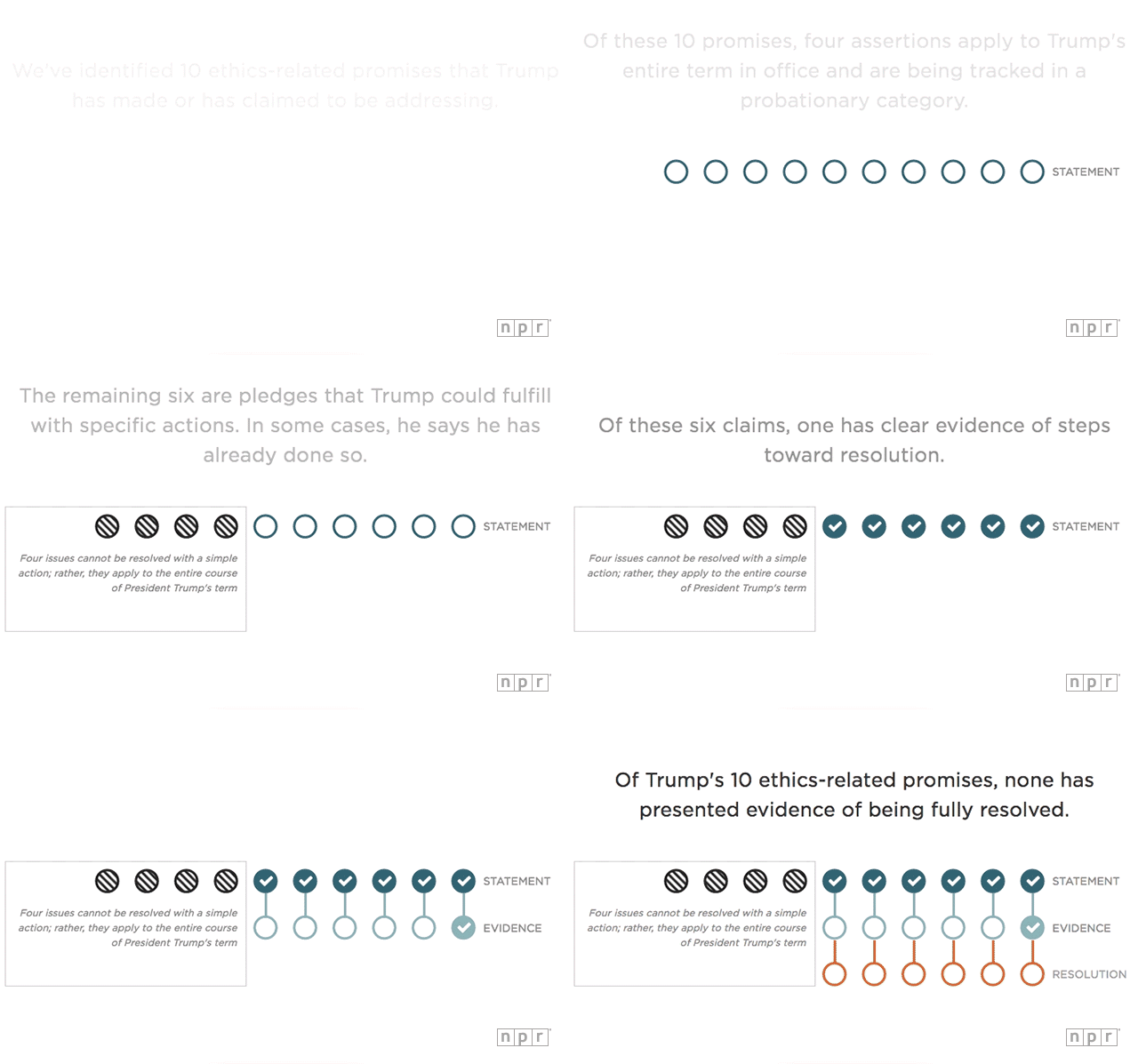
What Trump and his team have done is commit to certain steps that do touch on some of the ethics and conflicts-of-interest concerns. The Trump Ethics Monitor focuses on those promises and tracks their status.
Trump Ethics Monitor: Has The President Kept His Promises?
GIF: NPR
Attend a Resistance Recess Event: Save our Health Care, our Communities, and our Democracy
WATCH: Thousands take part in #DayWithoutImmigrants protests across the US on Thursday. nbcnews.to/2lmcTHA
2/16/17
Dear anti-Trump protesters: don’t forget those of us with disabilities
Feb 10, 2017, 8:00am EST
…
Now Disability March organizers are urging people to
start their own marches and include a “disability contingent,” allowing
people with disabilities to participate virtually through an organizer’s
self-hosted website, and by proxy as more capable people march on the
streets. As disheartening as it was to not be able to participate in the
recent protests, the thought of joining a contingent of disabled people
online gives me hope for future demonstrations...
Now as anti-Trump demonstrations continue — with
science-related protests, work stoppages, calls for the president’s tax
forms to be released, and boycotts of consumer spending all in the works
— I urge organizers to be more inclusive with their demonstrations.
Adopt virtual and proxy formats. Doing so will only increase the
protest’s impact — more people will participate, and more people will
take notice. That is, after all, what every good protest is about.
Dear anti-Trump protesters: don’t forget those of us with disabilities
Chaffetz asks Trump for information about Mar-a-Lago security
By Elise Viebeck February 14 at 3:37 PM
Rep. Jason Chaffetz is asking the White House for information about security protocols at Mar-a-Lago after Trump pored over documents related to North Korea at a table on the club’s outdoor terrace.
…
Trump conferred with aides, spoke on the phone and looked over documents on the club’s terrace Saturday night after North Korea test-fired a ballistic missile, its first such test since Trump took office. The flurry of activity took place a few steps from where club members were dining, and some guests posted photos of the scene on social media.
…
The White House has denied Trump handled sensitive information on the Mar-a-Lago terrace. Trump spokesman Sean Spicer told reporters Tuesday that Trump was briefed about the missile test in a SCIF before his dinner on the terrace.
Chaffetz asks Trump for information about Mar-a-Lago security
 Hearseeno