hearseeno:

5/10/17

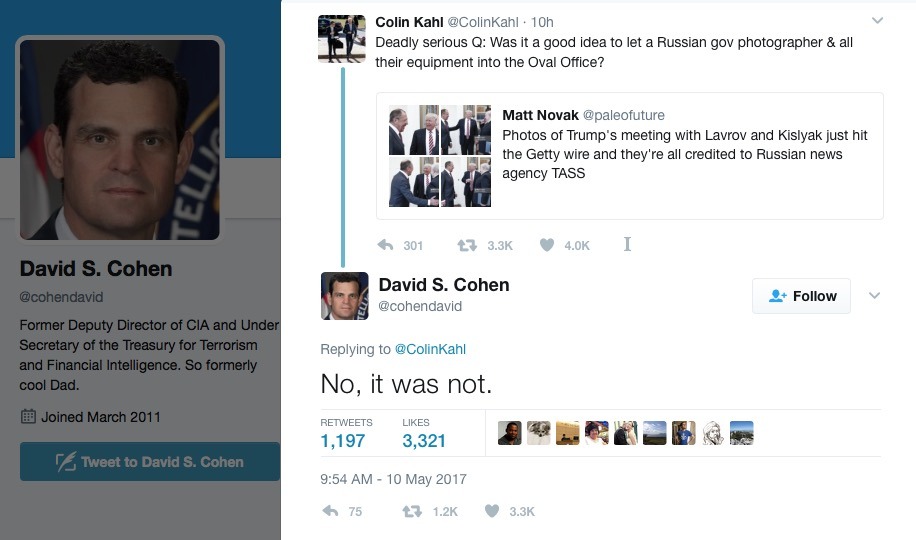
Colin Kahl asks:  Deadly serious Q: Was it a good idea to let a Russian gov photographer & all their equipment into the Oval Office?

Former Deputy Director of CIA and Under Secretary of the Treasury for Terrorism and Financial Intelligence David S. Cohen replies: No, it was not.

Presence of Russian photographer in Oval Office raises alarms

By Carol Morello and Greg Miller May 10 at 9:23 PM

The Washington Post

The administration official also said the White House had been misled about the role of the Russian photographer. Russian officials had described the individual as Lavrov’s official photographer without disclosing that he also worked for Tass.

We were not informed by the Russians that their official photographer was dual-hatted and would be releasing the photographs on the state news agency,” the administration official said.

As a result, White House officials said they were surprised to see photos posted online showing Trump not only with Lavrov but also smiling and shaking hands with Russian Ambassador Sergey Kislyak.

5/10/17

Colin Kahl asks:  Deadly serious Q: Was it a good idea to let a Russian gov photographer & all their equipment into the Oval Office?

Former Deputy Director of CIA and Under Secretary of the Treasury for Terrorism and Financial Intelligence David S. Cohen replies: No, it was not.

How Trump’s anger and impatience prompted him to fire the FBI director

Trump was angry that Comey would not support his baseless claim that President Barack Obama had his campaign offices wiretapped. He was frustrated when Comey revealed in Senate testimony the breadth of the counterintelligence investigation into Russia’s effort to sway the 2016 U.S. presidential election. And he fumed that Comey was giving too much attention to the Russia probe and not enough to investigating leaks to journalists.

In the weeks leading up to Comey’s firing, Trump administration officials had repeatedly urged the FBI to more aggressively pursue leak investigations, according to people familiar with the discussions. Administration officials sometimes sought to push the FBI to prioritize leak probes over the Russia interference case, and at other times urged the bureau to investigate disclosures of information that was not classified or highly sensitive and therefore did not constitute crimes, these people said.

In his Tuesday letter dismissing Comey, Trump wrote: “I greatly appreciate you informing me, on three separate occasions, that I am not under investigation.” People familiar with the matter said that statement is not accurate, although they would not say how it was inaccurate.

Within the Justice Department and the FBI, the firing of Comey has left raw anger, and some fear, according to multiple officials.  … One intelligence official who works on Russian espionage matters said they were more determined than ever to pursue such cases. Another said Comey’s firing and the subsequent comments from the White House are attacks that won’t soon be forgotten. Trump had “essentially declared war on a lot of people at the FBI,” one official said. “I think there will be a concerted effort to respond over time in kind.”

Dating to the campaign, several men personally close to Trump deeply distrusted Comey and helped feed the candidate-turned-president’s suspicions of the FBI director, who refused to bring charges against Clinton for what they all agreed was a criminal offense, according to several people familiar with the dynamic.

The media explosion was immediate and the political backlash was swift, with criticism pouring in not only from Democrats, but also from some Republicans. Trump and some of his advisers did not fully anticipate the ferocious reaction — …  Trump’s team did not have a full-fledged communications strategy for how to announce and then explain the decision. As Trump, who had retired to the residence to eat dinner, sat in front of a television watching cable news coverage of Comey’s firing, he noticed another flaw: Nobody was defending him.

The president was irate, according to White House officials. Trump pinned much of the blame on Spicer and Dubke’s communications operation, wondering how there could be so many press staffers yet such negative coverage on cable news — although he, Priebus and others had afforded them almost no time to prepare. 

How Trump’s anger and impatience prompted him to fire the FBI director

CNN exclusive: Grand jury subpoenas issued in FBI’s Russia investigation

5/9/17

Washington (CNN)Federal prosecutors have issued grand jury subpoenas to associates of former National Security Advisor Michael Flynn seeking business records, as part of the ongoing probe of Russian meddling in last year’s election, according to people familiar with the matter. CNN learned of the subpoenas hours before President Donald Trump fired FBI director James Comey.

The subpoenas represent the first sign of a significant escalation of activity in the FBI’s broader investigation begun last July into possible ties between Trump campaign associates and Russia. The subpoenas issued in recent weeks by the US Attorney’s Office in Alexandria, Virginia, were received by associates who worked with Flynn on contracts after he was forced out as director of the Defense Intelligence Agency in 2014, according to the people familiar with the investigation.

CNN exclusive: Grand jury subpoenas issued in FBI’s Russia investigation

Crain’s Chicago Business

The outrage surrounding United Airlines’ brutal treatment of a customer has made one thing crystal clear: The story isn’t really about airline travel, overbooking policies or even consumer rights. It’s about the nature of dignity itself, and it doesn’t reflect well on the society it has so preoccupied.

The algorithm that decided to bump Dr. David Dao from an overbooked flight was trained to find the “lowest value customer” to inconvenience — a coach passenger, naturally, not a business traveler, but also a passenger who had paid less than others and wasn’t a rewards member. In addition, the algorithm considered the immediate cost to the airline of bumping someone, which meant avoiding families, or requiring an overnight stay, to save reimbursement fees.

There are countless examples like this online. For example, the websites of various companies — including Capital One Financial Corp. — have used data from people’s computers to help determine their value as customers and decide what specific products or perks to offer them. Some companies even size you up when you call customer service numbers. If you’re high-value, you get connected to an agent quickly. If not, you can stay on hold indefinitely.

It’s the consumer reality, and it’s not pretty — especially when people start to accept ideas like making online privacy available only to those willing and able to pay for it.

We have fallen for this paradigm shift, in every conversation about Dr. Dao’s consumer rights, the exact definition of “boarding the plane” and whether he has grounds to sue. The underlying assumption is that we deserve dignity, but only if we’ve paid for it.


Our economy is a hellscape for consumers. The United flier is the latest victim.

The Washington Post

By Jacob Silverman April 12 2017

Air travel is the most concentrated version of an essentially authoritarian experience that can be found throughout today’s economy. We live, work, shop, and travel under a system of grossly asymmetric power relationships, in which consumers sign away most of their rights just by purchasing a ticket and companies deputize themselves to enforce contracts with hired goons. It doesn’t help that the Trump administration is rapidly stripping away as many regulations as it can, promising to repeal two for every new one implemented — an ultra-wealthy administration’s attempt to formalize the plutocratic free-for-all that has followed decades of growing corporate power, defined by massive income inequality, regulatory capture, a revolving door between agencies and the industries they oversee, and steadily eroding consumer rights.

Survey the economic landscape and you’re likely to find similarly scrambled power relationships. During the foreclosure crisis, banks acted like arms of the state, with local sheriffs becoming the banking industry’s eviction force. Health insurers dictate access to health care for millions while a small coterie of chief executives reaps huge payouts. The telecommunications industry has consolidated into a handful of industry behemoths that maintain regional monopolies. The result is a lack of competition and slow, pricey service. And soon, thanks to a provision recently passed into law by Congress, our ISPs will have the rights to sell all of our browsing data to whomever they choose.

Those are the economic costs of this arrangement. The social and cultural costs are harder to define but no less important. As Sandel explains, common experiences become increasingly fragmented and subjected to the vicissitudes of the market: “At a time of rising inequality, the marketization of everything means that people of affluence and people of modest means lead increasingly separate lives. We live and work and shop and play in different places. Our children go to different schools.” It also means wildly diverging expectations, as traditionally guaranteed rights become more contingent and benefits accrue to the wealthy.

In the wake of the House passing the AHCA, I keep thinking about the Washington Post article, 

That’s the danger of having a businessman’s administration in the White House.   People and their rights get defined as commodities.  Health and safety are not valued in and of themselves, but only in terms of the return on investment.

Corporations have always been free to define their services and consumers in these terms, but now the government does.  We’re seeing the blending of corporations and government in ways that erode our rights even further.  

Crain’s Chicago Business

A Little-Noticed Target in the House Health Bill: Special Education

MAY 3, 2017

With all the sweeping changes the Republican bill would impose, little attention has been paid to its potential impact on education. School districts rely on Medicaid, the federal health care program for the poor, to provide costly services to millions of students with disabilities across the country. For nearly 30 years, Medicaid has helped school systems cover costs for special education services and equipment, from physical therapists to feeding tubes. The money is also used to provide preventive care, such as vision and hearing screenings, for other Medicaid-eligible children.

The new law would cut Medicaid by $880 billion, or 25 percent, over 10 years and impose a “per-capita cap” on funding for certain groups of people, such as children and the elderly — a dramatic change that would convert Medicaid from an entitlement designed to cover any costs incurred to a more limited program.

AASA, an advocacy association for school superintendents, estimates that school districts receive about $4 billion in Medicaid reimbursements annually. In a January survey of nearly 1,000 district officials in 42 states, nearly 70 percent of districts reported that they used the money to pay the salaries of health care professionals who serve special education students.

A Little-Noticed Target in the House Health Bill: Special Education

Trumpcare

anexplanationofunfortunateevents:

I am never going to tell you not to look into something for yourself.
I will, however, suggest that if you are going to dig into this bill,
maybe also set aside some time for a palate-cleanser, like Oliver
Twist, or The Hunger Games. What you need to know is that yes, it
is that bad
.
If you see a headline or snippet and think “pft,
that seems a little dramatic” then you should probably be
suspicious that the source is underselling it. 


This bill punishes people for things for which they are blameless:
receiving a cancer diagnosis, or having a baby through a c-section.
It punishes people for responsible behavior, like treating a chronic
health issue before it gets bad, and for really difficult and
admirable behavior, like reporting an abuser for the criminal he is
.

If you are going to read more, some terms:

ACA = Affordable Care Act = Obamacare

AHCA = American Health Care Act = this travesty

CBO = Congressional Budget Office. When you hear about them “scoring”
a bill, it means they’re approximating what implementing it will
cost. The House passed this bill without waiting for the CBO to tell them what it would cost. (Its estimate of Trumpcare 1.0 was horrifying, and a new study shows even worse outcomes.)

What you can do:

Find out who your member of Congress is and how they voted. If they
didn’t support the bill, then you can donate to one of the groups who are working to flip the house in 2018, such as Swing Left,
Daily Kos, or the DCCC. This will help them fund Democratic
challengers, and it might help scare some Republicans into line. 

If you’re represented by someone who did vote for the bill, punish
them. Make an example out of them so that your senators don’t think there will even be a short-term reward for supporting repeal

If you’re not involved in a local activist group, look up the Town
Hall Project
and Indivisible groups in your district. 

It’s also worth being ready to push your senator. Watch The Center
for American Progress (@amprog on Tumblr doesn’t seem to be
frequently updated, but they’re also on Facebook and Twitter), or Indivisible on Facebook or Twitter. They’ll tell you when it’s time to
move. 

And, as ever, when one of your dumber friends starts yelling about
WHY DIDN’T THE DEMOCRATS STOP THIS!! say “because Democrats are
in the minority, because people like you don’t bother to show up
for midterms.”

While House passes GOP health-care bill, Senate prepares to do its own thing

By Sean Sullivan, Paige Winfield Cunningham and Kelsey Snell

May 4 at 7:24 PM

Republican senators are signaling that their strategy will be rooted in crafting their own replacement for the Affordable Care Act. It remains unclear how closely that measure will resemble the one narrowly passed in the House on Thursday or whether Republican senators will resolve their stark differences.

A small group of GOP senators met Thursday morning in the office of Senate Majority Leader Mitch McConnell (R-Ky.) to begin outlining their health-care priorities, said Sen. John Cornyn (R-Tex.), McConnell’s top deputy.

The measure’s original version, introduced in March by Speaker Paul D. Ryan (R-Wis.), already contained elements at risk of being struck out in the Senate under budget reconciliation rules that allow tax and spending changes but not broader policy changes.

That proposal initially left many of the ACA’s insurance regulations alone — with the goal of ensuring it would pass muster with the Senate parliamentarian, a nonpartisan officer of the Senate who decides on what may go in a reconciliation bill — but not all of them.

The version of the bill the House passed Thursday undercuts the ACA’s insurance regulations even more by giving states a path to opt out of federal requirements for insurers to cover certain “essential” health benefits — and to allow them to charge sick people the same premiums as healthy people.

The GOP bill would allow insurers to charge older Americans five times what they charge younger people, as opposed to three times as much under current law.

And it would enable insurers to hike premiums by 30 percent for people who don’t remain continuously covered. Health-policy experts, including conservative ones, have noted that the parliamentarian may decide those provisions need to be stripped out.

While House passes GOP health-care bill, Senate prepares to do its own thing

House Republicans just passed Trumpcare. So what’s next?

reincepriebus:

Things this bill does:

  1. Only covers 5% of people with pre-existing conditions.
  2. Exempts Congress from the worst parts of this bill, though they say they’ll fix that.
  3. Lets insurers once again put annual and lifetime limits on coverage for people with employer plans, effectively ends Medicaid expansion, leaves gaps in benefits, threatens Medicaid home- and community-based services for people with disabilities, and more.

The bill goes on to the Senate, where many are saying it’s dead on arrival. Regardless, we need to send a message to House Republicans that they’ll pay for their “YES” votes by losing their seats. Here’s what you can do:

  1. Use Contacting Congress to find out who represents you in the House.
  2. If your representative voted “YES” [here’s the list]: Use Contacting Congress to call their office and tell them you disapprove of their vote.
  3. Whether your representative voted yes or not, do the following:
  4. Donate to SwingLeft’s campaign to raise funds for Democratic challengers to the 35 swing district Republicans who voted for TrumpCare.
  5. Use Town Hall Project to find out if your representative is holding a town hall during recess. So far, only 6 of the 217 are.
  6. Sign up to volunteer for SwingLeft and/or check out Indivisible Guide for more actions for you to take.

After you’ve done that, you can contact your Senators. Use the same website listed first above (Contacting Congress) to find your two Senators. Give them a call, show up at their town halls, and donate to their Democratic opponents if they indicate that they’ll vote for TrumpCare.

The only way we’re going to take down this bill is if we keep the pressure on the GOP and let them know that voting for it will result in them losing their seats.

  1. Find out if you’re registered to vote. If not, find out how to.
  2. Here are some answers to some questions you might have about registering.
  3. Student voters: This is for you.
  4. What to bring with you to the polls.
  5. Click here for more voting information, and to find out who’s going to be on your next ballot.

Special Elections coming up:

Most other midterms are November 6th, 2018. Get ready.