So while it looks like he had some crazy adventures and disregarded Starfleet at every turn, that’s a lie.
Most of the time, he spent every other episode calling back, following the strictest of laws, going through proper motions and channels. Every other action was court-martialed and brought to trial. He was, for the most part, a dedicated captain following Starfleet’s rules.
Just because he is now the reason for about two dozen more rules, doesn’t make him the crazy madman adventurer we see him as. Of course he differed from his orders, at times. But those are the most excusable times, and even then, after disobeying, he laid himself up for proper discipline. He knew he’d done wrong in the eyes of his superiors, but his conscience wouldn’t have let him do any different.
Kirk was a rule follower and a rule maker. And only on special circumstances, a rule breaker.
This is as canonical as it gets: Kirk even says as much about himself when talking about his time as a cadet. Even with the Kobayashi Maru, supposedly his “defining” moment of “coolness” and rebellion, Kirk cheats because of how upset he is about the possibility of making a non-perfect grade. Like: he would only violate the rules to protect his GPA 😐
And rather than breaking into the grading system and changing his grade(which would be easier), or trying to finagle extra work/easier grading to make up for it(which would also be easier since everyone, canonically, thinks he’s a hotty), he changes the test so a perfect conclusion is no longer impossible, then achieves that still very difficult, but possible, solution. That’s a very lawful way to “cheat”(and, coincidentally, one that makes it obvious that he cheated since the instructors know the test was designed to be unbeatable. That he wasn’t drummed out for it shows how much Starfleet admires quick-thinking and pluck, so long as it doesn’t go too far).
I think people miss this because:
Movie Kirk is an almost totally different character from TV Kirk, and anyone born after the original run but before the prevalence of torrent sites(which is most fans these days) met Movie Kirk first. and
They don’t get how deeply Picard is a foil for Kirk.
I mean, they understand in a surface sense, in that Kirk is popularly seen as a “cowboy” and Picard is seen as a managerial diplomat, but it’s far deeper and more literary than that.
Kirk’s childhood is marred by horror. When he was 13 he was already off-world and lived through a planetary famine… and the eugenicist massacre the colony’s governor implemented to “save” it. These experiences had a huge impact on him and his morality, and shaped the grim, serious, humorless, friendless and by-the-books student he was in the academy.
His career after the academy, and particularly his time as Captain, taught him how to be himself; how to come out of the shell of duty he protected himself from others with, and the dark impulses he realized were within all humans, after Tarsus IV. And it also taught him the importance of his own morality; that while you honor the code of conduct and follow it as much as you can, sometimes adherence to its values and the “humanity” it is meant to instill and promote, require crossing those rules, even as it also requires you face the consequences of that violation.
Picard is the reverse. The shows and movies don’t go much into his early life, but we know he grew up in a loving and supportive, multi-generational family, who didn’t approve of his ambition to join starfleet. So Picard’s career began in an act of rebellion, and that quality of his character -his arrogance and willingness to spit in the face of tradition and convention; his propensity for running mad risks(because he didn’t really know what consequences were)- stayed with him through to graduation. Until his fight with the Nausicaans. A lesson quickly followed up with the Stargazer incident.
Picard’s life was safe until Starfleet, and his life in Starfleet taught him -at the edge of a knife; through his repeated near-death, and the deaths of his friends and mentors at the hands of unknown, unsuspected, almost unseen assailants- why rules existed and why caution, information-gathering, and diplomacy are so important. His early experiences in Starfleet taught Picard to temper his ambition and passion -his tendency to put himself and his assessments before everything else- with restraint, respect for others, and dutifulness to the ethics of his profession.
Picard had to learn to settle down, respect the fragility of life, and trust the rules; Kirk had to learn to be assertive, that hard situations require risk and sacrifice, and to trust himself. Both learned through Starfleet how to balance who they were and the things they believed in with the ethics and heavy responsibilities of their profession. This is a story about two people arriving at the same place(the most respected and trusted officer in the Fleet, entrusted with its flagship) from very different beginnings, and the sort of values and people Starfleet rewards. . . . . . . . . Though I’d have liked if they weren’t both farmboys. ST sure loves its agricultural origin stories :T
Onto the main cuz my maintuals all should know this.
No, but I think it’s really interesting that Sam being upset by not having had a relationship with Mary is pretty obviously the show retro-patching a writing mistake. Because Sam’s difficulties are in some ways very meta: what is it like to live in a universe that’s constituted from someone else’s emotional POV? How would that shape someone? How do you survive as a convincing, functioning character in that world?
And, despite the occasional really heartbreaking moment like that one in 13.4 or like 8.23, the answer is NOT that it makes a character a woobie. Sam at core is an immensely adaptable, immensely skilled survivor. I keep coming back to soulless!Sam for that: soulless!Sam chose to hunt and took numerous unnecessary physical risks, he wasn’t about self-preservation in that sense, but he reacted extremely to an existential threat against his existence as a self, the possibility that he’d be canceled, or left in a vegetative state. Sam’s had a fair number of canonically suicidal periods and self-destructive arcs, but his adaptive resilience almost never really disappears.
Soullessness was an accidental and unchosen maiming of selfhood, but a lot of Sam’s selfhood is underground a lot of the time – his empathy, genuinely admirable though it is, often doubles as dissociation – and I don’t think it’s because Sam is selfless in some cloyingly sentimental sense. I think it’s because he’s obliquely, cannily if unconsciously, hardy. It’s part of the reason why my brain tends to go in weird natural history directions when writing Sam fic. Things that look bizarre make sense when you think of them as about functioning in an environment.
To clarify the “not a woobie” thing: I do absolutely think that Sam is a victim, and that Sam is often Dean’s victim, and I’d hesitate to say that just because some of his responses to that are coping strategies, things SAM does, that that means he “lets” the ways in which he’s a victim happen. That would have very unfortunate implications to me.
I always have trouble phrasing my perception of Sam in a way that doesn’t make it sound as though I think Sam is invulnerable. Sam’s survival mechanisms are adaptations to damage; the fact that damage is so constitutive of his environment that he’s evolved into a creature who is incredibly, multifacetedly efficient at living in damage is quietly horrific. And, of course, all those elaborate spiny things and interesting bits of armor don’t prevent a creature from being periodically smashed.
(More lightheartedly, if you define woobie as “character whose responses to trauma tickle your id” then Sam’s very lack of woobieness is certainly id-tickling enough to me to qualify him for me. Or if you define it as “a character who is damaged in very sympathetic ways” that, too, applies.)
The way that I understand is that both Dean and Sam are the product of a highly enmeshed and rigid family system. In an enmeshed system, who you are, how you feel, what you believe, and what you do, is everyone’s business. In a rigid system, you have to comply in order to be a part of the system. There are tremendous forces in the system that with either force you to submit to the system or, if you don’t, will expel you from the system. Someone who is part of that kind of a system is forced to excise portions of who they are in order to remain a part of the system. That is the price they pay in order to “stay safe,” aka keep the system intact.
Dean cut off large portions of himself from very early on, particularly after the flashback events with the Shtriga from “Something Wicked” in season one. He learned that if he didn’t, he was going to lose his father’s regard and his brother’s life. So, in between John giving Dean the role of protector and these kinds of lessons, Dean most often takes on a homeostatic role. His characterization has become more complex over the seasons, but he often does things that keep the family stable as defined by John: rigid, enmeshed, and adherent to the principles of “Saving people, hunting things, the family business” and “Keep Sam safe.”
Sam, on the other hand, lost control over his life trajectory because of being the object of “Keep Sam safe.” That’s a very passive, disempowered role. Ever since childhood he seems to vacillate over that line – feel empowered, want things, and take action to get them = be expelled from the family, shamed, fuck up. Want college – get shamed for not sacrificing enough of yourself and expelled. Want a dog? Get shamed. Avoid sacrificing a part of yourself (like attempting to sell your soul, or get involved in dark, dark things) in order to get your family back? Get shamed. Get mad that your brother violated your physical autonomy? You lose your brother and the family falls apart. And then swing to the other side: comply, fully commit to being a hunter, do things that cross a line into dark, dark territory? Also get push back, because “Keep Sam safe” also means “don’t let him turn into a monster.” Sam’s role to fit into this particular system is to be the passive, disempowered one – the only way to fit that role is to cut off very large parts of yourself slowly over time. It prioritizes the needs of the system over the individual.
If you want to be a part of that kind of a system, then you must get rid of anything that reeks of autonomy. The “woobie-Sam” image makes me very uncomfortable. At it’s core, it’s martyrdom, prioritizing others’ needs at the cost of your own, until you have very little self left. We tend to glorify that kind of martyrdom in our society, but it is dark, scary stuff to be a part of a system that requires it of you.
Next, her entrance into the room is proceeded by a goat with horns….
and there she stands again with horns above her head. Hmmmmmmm.
Mick’s history so closely paralleled Sam and the Azazel’s children death match in the same season that we’ve been introduced to the other yellow-eyed demons.
What do you want to bet it’s the British Men of Letters that have been compromised?
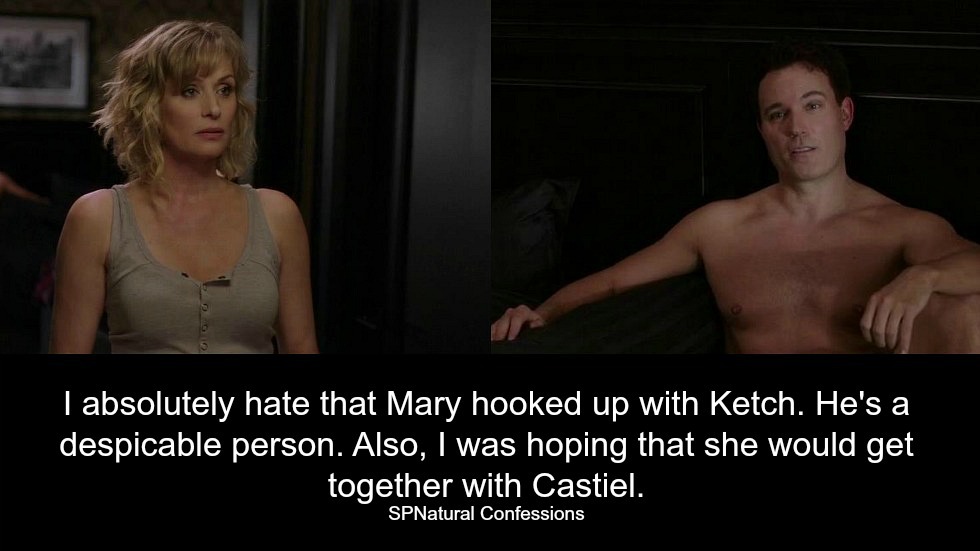
Do you kinda wonder about the state of Mary’s soul?
I watched Lily Sunder Has Some Regrets again last night, and I keep thinking about the parallels between her and Mary. Two mothers avenging what supernatural forces had done to their children, and it’s costing them their souls.
Next, her entrance into the room is proceeded by a goat with horns….
and there she stands again with horns above her head. Hmmmmmmm.
Mick’s history so closely paralleled Sam and the Azazel’s children death match in the same season that we’ve been introduced to the other yellow-eyed demons.
What do you want to bet it’s the British Men of Letters that have been compromised?
There’s some interesting things going on with eyes. Not sure what it means yet, but in an episode where Sam’s soul was going to be traded for the witch guy’s soul, maybe the windows to the soul matter. I dug up these pics because seemed like it might matter. I mean the voodoo doll didn’t have to have a missing eye. Seems like it might be something.
Don’t forget Scooby Doo getting shot in the eye with water – on the TV while Dean is watching – in this ep as well.
Oh, I forgot that. That was the other thing. There was a bunch of dog references. Dean’s told to “stay” multiple times in the ep, Scooby Doo…
(apologies for the utterly disjointed ramblings below. I’m pre-coffee)
In an episode about memory, in a season about thoughts and memory, we have an awful lot of missing eyes. Now i feel like I need to do a rewatch looking for ravens.
I’m going to Odin with this one. I’m not sure how he fits in (particularly since he’s dead-ish since season 5 [my thoughts on whether or not Gods can actually die is besides the point.]), but that’s where my brain is going.
Odin sacrificed one eye to drink from the Well of Poetry/Wisdom/Knowledge. It takes the loss of an eye to gain knowledge/wisdom.
That’s what Charlie and Lily have done. Lily far more literally than Charlie. Charlie too though, ‘loses’ an eye in the episode where we learn she’s started hunting, gaining knowledge.
Scooby Doo episode is Hassle in the Castle. Scooby finds a magic hat while he’s scouting ahead of the gang. First he pulls a rabbit out of the hat, then drum beats while it’s empty, then the flowers which squirt him in the eye. It’s a temporary blindness, that leads to VELMA saying she’s ‘starting to figure things out’
We never actually see Dean use the hex doll. He’s far more interested in the pins. I’m not sure what to make of that, perhaps knowledge un-used?
He does stab the doll though. He only stabs it through the head, the center of knowledge and whatnot. Did anyone notice too how the folks one eye moved about a bit oddly? Also I’m wondering who the figure represents. I’m now on the lookout for a yellow haired, one eyed enemy of Rowena.
Yeah, I saw that he did stab it in this morning’s gif sets (after I’d already responded.) I missed it last night, even while I was paying attention.
the hex doll has a googly eye, which is why it moved funny. I’m just not sure how it ties in.
Possibly Rowena wanted whoever that’s tied to (which yeah, that would be useful information! i was thinking lucifer, but all his recent vessels have been dark haired) to know what’s happening to them?
I read this a while ago (thank you to @elizabethrobertajones for helping me find it again!) and it lodged firmly into the back of my mind as “Thing to keep an eye on” (pun intended ;P) and it’s striking how often we get this visual, in particular in relation to Dean. In addition to the above examples, we have Lady Toni threaten Dean with the Sharp Pointy Stick of Ouch:
In the Foundry, the doll you’d give only to children you hate (found by Mary, so a minor exception to the rule?) is missing its left eye:
And then, most recently I believe (I’ll need to rewatch 12.15 to see if I’ve missed something there) you have this graffiti behind Ketch and Dean that may just be coincidence but the line through the eye is quite striking to me nonetheless.
Also, this might be part of the thing too?
I still can’t quite put a finger on what this symbolism is referring to, but given that I’m of the opinion that Bad Thing lies on Dean’s horizon this season, I don’t get feel good vibes from it.
“Here, play with this, and I’ll tell you a story.”
“I remember you. a rag doll all huddled up on our doorstep.”
And tears that I have covered with patches Red and yellow patterns, nothing I own matches, hey Where I have them sewn with black stitches Are made exposed to be soiled and tattered, hey
I’m just a little girl, I’m Raggedy Ann Making believe I’m happy, hey Raggedy Ann, falling apart at the seams
One of the main things that strikes me about “Mad Men” is how the issues of smoking and marketing and corporate greed run through the entire series with the lesson that it is the buyer who should beware. Our first clue is a cigarette in Don’s outstretched hand in the opening credits as life scrolls by before him.
The pilot episode is titled “Smoke Gets in Your Eyes”. In that episode, Don is working on his account for Lucky Strikes and has a conversation with a waiter in which they discuss the news in Reader’s Digest that smoking is bad for you. Don and the waiter dismiss this, but the waiter says his wife is concerned. “Ladies love their magazines”, they both agree.
In the final episode, “Person to Person”, Don and his ex-wife, Betty, discuss what will happen to their children now that Betty has been diagnosed with terminal lung cancer. In our final shot of Betty, we see their oldest child doing the dishes while her mother sits at the table smoking. Despite also smoking throughout the series, it’s not Don but his wife who will die. And, it is evident that the children will be called on to clean up the messes their parents left behind. As the marketing tool for corporate greed throughout the series, Don’s dismissal of the article in Reader’s Digest in the first episode has led to the imminent death of his wife and the mother of his children in the final episode.
Here in 2017, I keep seeing comparisons of how Big Sugar took a page from Big Tobacco’s marketing strategy to convince us all that sugar wasn’t so bad for us, and each time it makes me think back to the final scene of “Mad Men”.
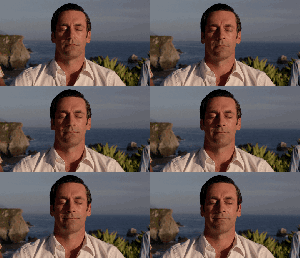
Betty Draper’s story is going to end in death caused by smoking. Big Tobacco plays an important part throughout the series, but in the end, it does appear that the smoke has finally cleared from Don’s eyes as he sits there meditating on the new day.
How does Don Draper’s story end? He’s going to offer the world a sugar-laden Coke.
Can we talk about Mary and Sam? In a single episode, Mary cycled through a lot of the things that have haunted Sam at certain points throughout the series—not feeling like she belongs. Admitting that the place others call “home” is not her home. Loving her family dearly but needing to seek a place where she can find herself. Feeling like she’s the odd one out in a trio. Mourning the loss of a loved one. Being left behind in hotel rooms while the others go out and hunt. Mary Winchester is a powerful hunter, but she’s empathetic and intuitive and seeks the truth behind the easy answers… like Sam.
Also like Sam, she spoke to her family and said she had to leave.
Like Sam, she faced rejection born of pain when she expressed her need to leave.
Unlike Sam… Mary Winchester has a son named Sam, who has been through all of those things, understands them intimately, accepted her decision, and had the strength to put her needs over his desire to have her beside him.
Sam Winchester, giving to others what he never received.
I’m just watching 10.05 Fan Fiction again, and at the VERY END when Maeve comes running down to the stage to tell Marie that the publisher’s ticket was claimed, THIS is her response:
MAEVE : The ticket you left for the publisher? Someone claimed it! (We see the arm of a man. When Marie sees him, she’s shocked.) MARIE : Oh my gosh! But wait… does that mean that– Calliope came for me or for–? MAEVE : Who cares? Go, fangirl!
So Marie’s very first thought on seeing Chuck, or Carver Edlund, is that maybe Calliope was there for him, because it had been his story first. But it was “Marie’s vision” they were writing and performing.
In the previous scene, though, she proved she really did understand that she was talking to “the real Dean” when she handed him the prop Samulet and told him to take it, calling him “jerk.” Dean reflex-replied “bitch,” and immediately realized how bad that must sound… But Marie just grins at him while Dean awkwardly shuffles away.
And it struck me funny, because when we see Chuck again at the end of s11, we see him repeatedly dodge claiming full responsibility for problems he’s directly responsible for. Beginning in 11.20 and running right up through the final scenes of 11.23, we see Chuck hiding out, writing a highly sanitized and self-glorifying version of his own story, foisting off the responsibility to clean up his own mess onto anyone and everyone else. He’s a hybrid slippery eel/weasel. He’s got an explanation and an excuse for everything. He’s the embodiment of obfuscation and denial whose solution to every problem is to lock it up and try to pretend it doesn’t exist.
While we’re here (and since it’s also a Robbie Thompson episode) I’ll also quickly bring up the scene in 11.04 where Sam is talking to “his dad” in his dream. I still think there’s a lot of evidence pointing to that not being Lucifer, but Chuck himself sending that particular vision to Sam.
And since 11.20 was also penned by Robbie, I think it’s only reasonable to tie a few things together for comparison’s sake. I think he was already setting up the culmination of Chuck’s story all the way back in 10.05, even if the full measure of Chuck (as God) wouldn’t finally unravel until the end of 11.23.
Metatron: It’s not. But you helped the Winchesters before. Chuck: Helped them? I’ve saved them! I’ve rebuilt Castiel more times than I can remember. Look where that got me. Metatron: So you’re just gonna let Amara win? Chuck: Eh, it’s her time to shine.
First of all, can I point out that he used the word shine to describe The Darkness? The dark don’t shine on its own…
Okay, back to the point (hopefully!).Compare what he’s said to Metatron here, that he’s saved the Winchesters (including Castiel) over and over again, but John said this to Sam back in 11.04:
SAM: No, my father is dead. JOHN: When has death ever stopped a Winchester? SAM: Look, I don’t know what this is, but – JOHN: What you said about relationships, wanting something more … I never wanted this for you boys. This life. Not really. SAM: We turned out okay. JOHN: You did, didn’t you? But that was on you boys. You did that, not me. SAM: Well, you played your part. JOHN: I did my best, anyway, for what it was worth. SAM: This isn’t real. JOHN: I never could fool you, could I?
Let’s start with death never having stopped a Winchester. In 11.20 quoted above, Chuck claims responsibility for all the Winchester resurrections. Death hasn’t stopped them only because Chuck has repeatedly interfered to make it so. Chuck needed the Winchesters to keep doing his work for him. Sure, he complained about all the work resurrecting them again and again created for him, but he still got to hide out and take the back seat while they did all the really grueling work for him. He played his part, for what it was worth, i.e. kept the Winchesters in the game to keep doing his wetwork.
Back in 11.04, “John” tells Sam that how the boys turned out was all on them. This entire exchange works if “John” is really Chuck, as well. He goes on to say:
SAM: I prayed when I was in that church, and I saw … Something. And now, here you are, whoever you are, whatever you are. What the hell is this? JOHN: Dream. Vision. Call it what you want. The message is still the same. The Darkness is coming … And only you boys can stop it. SAM: Okay, fine. How? We need help, not visions of dead people. JOHN: God helps those who help themselves. SAM: Who are you? Int. Impala: Sam wakes from his dream to find Dean has pulled over and is parked.
Sam has seen through the illusion, he knows it’s not really his dad, and then immediately implies that Sam thinks this is the same entity who sent him the vision back in 11.02. “John” neither confirms nor denies this, but the message of the previous vision Sam got was DEFINITELY not “the same” as what he’s receiving now. His previous vision wasn’t about the Darkness coming and only Sam and Dean being able to stop it. This is distinctly new information for Sam.
The “God helps those who help themselves” line has always bugged me, because that’s really what Chuck has always done, at least as far as the Winchesters are concerned. His help has never been particularly helpful, other than keeping them in play on his giant game board.
Telling Sam that “only you boys can stop it,” well… we know full well after 11.23 that no, ONLY Chuck and Amara themselves can stop it. Only going all the way back to the river’s ugly source can they actually stop it, and that source was Chuck betraying Amara and locking her away in the first place.
So finally getting back to the original point here, way back in 10.05 where Marie sort of sees straight through to the heart of the issue (since Robbie has just shown us that she also saw through Dean’s mask, much the same way he showed us that Mildred saw through his mask in 11.11.. Robbie loves writing the Wise Women), and got it even just for a second that hey, maybe Calliope wasn’t there to eat HER, but because of CHUCK being there. She was just the “puppet” that stood in for the REAL AUTHOR OF THE STORY.
I think even just for a split second, Marie realized she might have been nothing more than a proxy, a stand-in stunt double, for a higher power. Because we know from 11.20-11.23 that that is exactly Chuck’s modus operandi when it comes to handling his problems.
It’s what he tried to convince Sam to do in 11.04. It’s what he tried to convince Metatron to do in 11.20. It’s what he tried to convince EVERYONE to do in 11.22. It’s the responsibility he tried one last time to foist off to Dean with the ridiculous Soul Bomb plan. And finally in 11.23, Amara refused to let the game continue and brought them face to face to finally hash out their issues themselves. No more proxies, no more puppets, no more hiding.
And it all started with this one little acknowledgement to Marie. When she asked him what he thought of her version of his story, he said, “Not bad.”
It was the first step in him acknowledging one of his proxies and validating their work. And it only comes full circle at the end of 11.23 when he basically says the same thing to Dean.
Ugh, reblobbed again because I left off one of the points I wanted to add here, and that’s the fact that Chuck himself was the one who reminded me of Sam’s 11.04 dream again in 11.21:
Chuck: You’re frustrated. I get it. Believe me, I was hands-on – Real hands-on, for, wow, ages. I was so sure if I kept stepping in, teaching, punishing, that these beautiful creatures that I created… would grow up. But it only stayed the same. And I saw that I needed to step away and let my baby find its way. Being overinvolved is no longer parenting. It’s enabling. Dean: But it didn’t get better. Chuck: Wel,l, I’ve been mulling it over. And from where I sit, I think it has. Dean: Well from where I sit, it feels like you left us and you’re trying to to justify. Chuck: I know you had a complicated upbringing, Dean. But don’t confuse me with your dad.
Don’t confuse me with your dad.
Is it one more deflection from Dean’s accusations? One more attempt for Chuck to shift the blame and avoid the real issue: that everything has been one long slippery slope we can trace all the way back to locking up the Darkness.
And that reminded me of this post I made a while ago about whose fault this whole mess really is.
Okay, I need to stop thinking about this for a while now. 😀





 Hearseeno