Robert Mueller Saw Trump Coming in 2011 | Dame Magazine

“Some believe that organized crime is a thing of the past. Unfortunately, this is not the case. Traditional criminal syndicates still con, extort, and intimidate American citizens.

As you know, just last week we arrested nearly 130 members of La Cosa Nostra in New York, New Jersey, and New England. We will continue to work with our state and local partners to end La Cosa Nostra’s lifelong practice of crime and undue influence.

But the playing field has changed. We have seen a shift from regional families with a clear structure, to flat, fluid networks with global reach. These international enterprises are more anonymous and more sophisticated. Rather than running discrete operations, on their own turf, they are running multi-national, multi-billion dollar schemes from start to finish.

We are investigating groups in Asia, Eastern Europe, West Africa, and the Middle East. And we are seeing cross-pollination between groups that historically have not worked together. Criminals who may never meet, but who share one thing in common: greed.  

They may be former members of nation-state governments, security services, or the military. These individuals know who and what to target, and how best to do it. They are capitalists and entrepreneurs. But they are also master criminals who move easily between the licit and illicit worlds. And in some cases, these organizations are as forward-leaning as Fortune 500 companies.

This is not “The Sopranos,” with six guys sitting in a diner, shaking down a local business owner for $50 dollars a week. These criminal enterprises are making billions of dollars from human trafficking, health care fraud, computer intrusions, and copyright infringement. They are cornering the market on natural gas, oil, and precious metals, and selling to the highest bidder.

These crimes are not easily categorized. Nor can the damage, the dollar loss, or the ripple effects be easily calculated. It is much like a Venn diagram, where one crime intersects with another, in different jurisdictions, and with different groups.

How does this impact you? You may not recognize the source, but you will feel the effects. You might pay more for a gallon of gas. You might pay more for a luxury car from overseas. You will pay more for health care, mortgages, clothes, and food.  

Yet we are concerned with more than just the financial impact. These groups may infiltrate our businesses. They may provide logistical support to hostile foreign powers. They may try to manipulate those at the highest levels of government. Indeed, these so-called “iron triangles” of organized criminals, corrupt government officials, and business leaders pose a significant national security threat.

Let us turn for a moment to the link between transnational organized crime and terrorism. If a terrorist cannot obtain a passport, for example, he will find someone who can. Terrorists may turn to street crime—and, by extension, organized crime—to raise money, as did the 2004 Madrid bombers.

Organized criminals have become “service providers.” Could a Mexican group move a terrorist across the border? Could an Eastern European enterprise sell a Weapon of Mass Destruction to a terrorist cell? Likely, yes. Criminal enterprises are motivated by money, not ideology. But they have no scruples about helping those who are, for the right price.

Intelligence and partnerships are key to our success in countering these threats.  

In the past nine years, we in the FBI have shifted from a law enforcement agency to a national security service that is threat-driven and intelligence-led.

With organized crime, we are using intelligence to expand upon what we already know, from phone, travel, and financial records to extensive biographies of key players. And we are sharing this information with our partners around the world.

But we are also building a long-term strategy for dismantling these enterprises. Last year, we set up two units, called Threat Focus Cells, to target Eurasian organized crime. The first focuses on the Semion Mogilevich Organization; the second on the Brother’s Circle enterprise.

For those of you not familiar with either group, their memberships are large, their reach is global, and their scope of operations is broad, from weapons and drug trafficking to high-stakes fraud and global prostitution. If left unchecked, the resulting impact to our economy and our security will be significant. Indeed, Semion Mogilevich is on the FBI Top Ten Most Wanted List, and he will remain so until he is captured.”

Robert Mueller Saw Trump Coming in 2011 | Dame Magazine

One common abbreviation used in Roman letters was SPD, which was short for salutem plurimam dicit, or “sends many greetings.” This served as a greeting at the beginning of a letter, to indicate the sender and the receiver, as in “Marcus Sexto SPD” (“Marcus sends many greetings to Sextus”). Another popular acronym was SVBEEV, which was short for si vales, bene est, ego valeo (“if you are well, that is good, I am well”). Such abbreviations saved space and time, just as acronyms (BTW, AFAIK, IANAL) do today in Internet posts and text messages.
Tom Standage,

Writing on the Wall: Social Media – The First 2,000 Years

(via pythionice)

hey what’s up with the “!” in fandoms? i.e. “fat!” just curious thaxxx <3

cesperanza:

cesperanza:

raincityruckus:

nentuaby:

hosekisama:

michaelblume:

molly-ren:

stevita:

molly-ren:

molly-ren:

I have asked this myself in the past and never gotten an answer.

Maybe today will be the day we are both finally enlightened.

woodsgotweird said: man i just jumped on the bandwagon because i am a sheep. i have no idea where it came from and i ask myself this question all the time

Maybe someone made a typo and it just got out of hand?

I kinda feel like panic!at the disco started the whole exclamation point thing and then it caught on around the internet, but maybe they got it from somewhere else, IDK.

The world may never know…

Maybe it’s something mathematical?

I’ve been in fandom since *about* when Panic! formed and the adjective!character thing was already going strong, pretty sure it predates them.

It’s a way of referring to particular variations of (usually) a character — dark!Will, junkie!Sherlock, et cetera. I have suspected for a while that it originated from some archive system that didn’t accommodate spaces in its tags, so to make common interpretations/versions of the characters searchable, people started jamming the words together with an infix.

(Lately I’ve seen people use the ! notation when the suffix isn’t the full name, but is actually the second part of a common fandom portmanteau. This bothers me a lot but it happens, so it’s worth being aware of.)

“Bang paths” (! is called a “bang"when not used for emphasis) were the first addressing scheme for email, before modern automatic routing was set up. If you wanted to write a mail to the Steve here in Engineering, you just wrote “Steve” in the to: field and the computer sent it to the local account named Steve. But if it was Steve over in the physics department you wrote it to phys!Steve; the computer sent it to the “phys” computer, which sent it in turn to the Steve account. To get Steve in the Art department over at NYU, you wrote NYU!art!Steve- your computer sends it to the NYU gateway computer sends it to the “art” computer sends it to the Steve account. Etc. (“Bang"s were just chosen because they were on the keyboard, not too visually noisy, and not used for a huge lot already).

It became pretty standard jargon, as I understand, to disambiguate when writing to other humans. First phys!Steve vs the Steve right next to you, just like you were taking to the machine, then getting looser (as jargon does) to reference, say, bearded!Steve vs bald!Steve.

So I’m guessing alternate character version tags probably came from that.

100% born of bang paths. fandom has be floating around on the internet for six seconds longer than there has been an internet so early users just used the jargon associated with the medium and since it’s a handy shorthand, we keep it.

I am more than 90 percent sure that the first bang!character was Mulder–you had like, Something!Mulder.   Oldos of fandom, back me up on this?

HA–fanlore agrees with me.  There’s an entry.  There’s always an entry!!

(Fanlore gothic: There is an entry on fanlore. There is always an entry on fanlore. The fandom hasn’t even happened yet and there’s an entry on fanlore. We are all about to die in the apocalypse and there’s an entry about it already on Fanlore)

Ahahaha, and the entry on Fanlore already LINKS TO THIS POST. Holy endless recursion, Batman!!

littlehollyleaf:

mooseleys:

fyi yes this does exist

okay look

I just can’t get this out of my brain so I’m gonna attach it to this post for all to be plagued by –

IS THIS a reference to CASIFER?

‘weasel’ can refer to “a deceitful or treacherous person” (ie. Lucifer) OR “achieving something by use of cunning or deceit” (eg. to weasel your way into someone’s affections ie. what Casifer is attempting to do with Dean)

the weasel is RIDING the woodpecker (ie. like Luci is ‘riding’ Cas right now by taking control of his vessel), but also, according to the linked article, ATTACKING the woodpecker as opposed to working with it (ie. like Luci and Cas are, in fact, antagonistic towards each other, even though they similarly might appear to have teamed up) 

(’woodpecker’ is probably slang for being into cock somehow as well so could relate to Cas because of that, heh – JK! …or am I?)

so, yeah… y/n?

if it IS referencing Casifer somehow, this might bode well, since this was the outcome of the weasel’s attack –

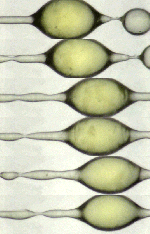
…the weasel was attacking the bird. Fortunately, the bird escaped.   

Interesting!