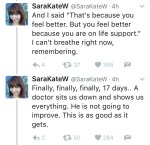
rallyforbernie:

This is what Republicans try to demonize for political gain. Think about it.

It’s called Advanced Care Planning.  Here’s some facts about Advanced Care Planning in the ACA, Medicare and Medicaid.  

Here’s Keith Olbermann talking about a similar experience from 2010 and his disgust with politicians who harm everyone when they spin Advanced Care Planning as Death Panels.

Here is the text of the proposed section of the ACA (HR 3200, Section 1233), if you want to check it out yourself.  It starts on page 454.

I’ve been on the other end of this discussion. I’ve been one of the hospital staff members who laid at what we know, what we don’t know, answered questions, and just simply sat with parents who are trying to make the most heartrending decision of their lives.  Using provisions like this as a weapon for political means is morally bankrupt.  

Rep Tom Price – plans for medicaid as nominee for secretary of DHHS

What many people don’t yet know is that Price, House Speaker Paul Ryan, and Trump have proposed making significant changes to Medicaid, the health insurance program that covers low-income people, including those with disabilities. These changes are not to make the program more efficient. Medicaid is significantly more efficient than private insurance; these changes are to finance tax cuts. The plan is to slowly reduce the dollars available, so that at the end of ten years, $1 trillion will have been cut from healthcare for poor people and people with disabilities.

Not surprisingly,  these cuts would be devastating.  What is more, the changes in how the system is run would  risk the fundamental right to freedom for people with significant disabilities.

But Price and many other members of Congress want to turn back the clock and undo all of our hard-fought gains. They seek a radical restructuring of Medicaid that will allow them to significantly cut funding to the program. They propose turning the program into a “block grant” or by instituting a “per capita cap,” meaning that states would receive a fixed amount of dollars, and the federal government would no longer provide oversight or incentives. The federal oversight and incentive programs are what have reformed state systems to move from institutional care to community-based services. The result would be dangerously reduced benefits that support the autonomy of people with disabilities.  

Here’s my two cents from working in health care:

This comes at the same time as repealing but not replacing the ACA.  The ACA has provisions to help fund rural and underserved area hospitals. The ACA expands the number of hospitals that qualify for Medicare Dependent Hospital (MDH) support – read rural poor hospitals here.  (The ACA mandate to expand Medicaid coverage in every state was supposed to help them out even further – but the Supreme Court blocked the mandate and the states got to choose.)  

Together cuts to Medicaid and repeal of the ACA leave people with disabling conditions even more underserved and at risk.  With these deep cuts, people will no longer be able to pay for care and care that is local to them is either likely to disappear or, if it’s still there, will be even less able to absorb the cost involved in providing services to people who can’t pay.    

And don’t forget, an average of half of enrollees in Medicaid are children.  Medicaid (along with CHIP and TEFRA) allows children with disabilities and chronic medical conditions to receive medical and therapeutic care that makes a huge difference in their lives.  It’s the great societal leveler that allows families who couldn’t afford it otherwise to access the kind of care that can make a huge difference in the child and family’s health and autonomy. Or just… continuance of life, to be honest.  If you want to know what the states are inclined to do with block grants without federal oversight, you have to look no further than Texas, that made $350 million in cuts in reimbursement to early childhood therapists just this December. 

Without decently funded Medicaid, it creates greater dependence on the school system to provide therapies – whose mandate is to only address those things that help the child benefit from instruction.  This comes at the same time as Betsy DeVos and her platform of vouchers and charter school, freeing up public funds for private schools.  Don’t forget, private schools are not mandated to serve children with disabilities.  The IDEA doesn’t cover private institutions.  Private schools can reject whatever student they want to.  Even public charter schools tend to discriminate against children with special education needs.  

And it’s all going to hit the rural poor first. 

Aetna claimed this summer that it was pulling out of all but four of the 15 states where it was providing Obamacare individual insurance because of a business decision — it was simply losing too much money on the Obamacare exchanges. Now a federal judge has ruled that that was a rank falsehood. In fact, says Judge John D. Bates, Aetna made its decision at least partially in response to a federal antitrust lawsuit blocking its proposed $37-billion merger with Humana. Aetna threatened federal officials with the pullout before the lawsuit was filed, and followed through on its threat once it was filed. Bates made the observations in the course of a ruling he issued Monday blocking the merger. Aetna executives had moved heaven and earth to conceal their decision-making process from the court, in part by discussing the matter on the phone rather than in emails, and by shielding what did get put in writing with the cloak of attorney-client privilege, a practice Bates found came close to “malfeasance.” The judge’s conclusions about Aetna’s real reasons for pulling out of Obamacare — as opposed to the rationalization the company made in public — are crucial for the debate over the fate of the Affordable Care Act. That’s because the company’s withdrawal has been exploited by Republicans to justify repealing the act. Just last week, House Speaker Paul Ryan (R-Wisc.) cited Aetna’s action on the “Charlie Rose” show, saying that it proved how shaky the exchanges were. Bates found that this rationalization was largely untrue. In fact, he noted, Aetna pulled out of some states and counties that were actually profitable to make a point in its lawsuit defense — and then misled the public about its motivations.

U.S. judge finds that Aetna misled the public about its reasons for quitting Obamacare – LA Times
(via shayera-librarian)

Guys, spread this far and fucking wide. They lied about losing money. The Republicans seized on that for their “failing Obamacare” fairy tale, and a judge just ruled that was bullshit.

(via drst)

BREAKING: Federal Judge Halts Obamacare Transgender, Abortion-Related Protections Nationwide Effective Immediately

tpfnews:

WASHINGTON — A federal judge in Texas on Saturday issued a nationwide injunction halting enforcement of Obama administration protections for transgender and abortion-related healthcare services just one day before they were due to go into effect.

The lawsuit — brought by Texas, a handful of other states, and some religiously affiliated nonprofit medical groups — challenges a regulation implementing the sex nondiscrimination requirement found in the Affordable Care Act (ACA).

The Health and Human Services (HHS) regulation “forbids discriminating on the basis of ‘gender identity’ and ‘termination of pregnancy’” under Obamacare, as US District Court Judge Reed O’Connor wrote in his opinion halting enforcement of those provisions in the rule.

Explaining the lawsuit, O’Connor wrote, “Plaintiffs claim the Rule’s interpretation of sex discrimination pressures doctors to deliver healthcare in a manner that violates their religious freedom and thwarts their independent medical judgment and will require burdensome changes to their health insurance plans on January 1, 2017.”

The states and nonprofits in the healthcare lawsuit allege that the regulation violates the Administrative Procedure Act (APA) — which sets the rules for federal government rule-making — and the Religious Freedom Restoration Act (RFRA).

O’Connor found that the plaintiffs had standing to bring the lawsuit because they “have presented concrete evidence to support their fears that they will be subject to enforcement under the Rule.”

Spokespersons from the Justice and Health and Human Services departments did not immediately respond to a request for comment. The next steps from the administration could include seeking to appeal the injunction or asking O’Connor to limit his order to the plaintiffs in the case, although it was not clear — with 20 days left in the Obama administration — what the government would choose to do.

White House officials also did not immediately respond to a request for comment.

O’Connor is the same trial court judge assigned to a lawsuit brought by several states, again led by Texas, challenging the Obama administration’s transgender protections in schools provided under Title IX of the Education Amendments of 1972.

In August, O’Connor issued a nationwide injunction halting enforcement of the Obama administration’s schools guidance because he found it was not permitted under Title IX. (The administration is challenging the nationwide scope of the injunction at the US Court of Appeals for the Fifth Circuit.)

Because Title IX is referenced as providing the basis for the ACA’s sex discrimination ban, O’Connor found, accordingly, that “HHS’s expanded definition of sex discrimination exceeds the [Title IX] grounds” provided for in the ACA, making that provision contrary to law and a violation of the APA.

O’Connor similarly found that the rule’s failure to include the religious exemptions found in Title IX similarly “renders it contrary to law.”

The judge also found a “substantial likelihood” that the states and nonprofits would succeed in their RFRA claim.

O’Connor found that because “numerous” other options were available to the government for “expand[ing] access to transition and abortion procedures,” the rule is not the “least restrictive means” of advancing that interest — as required by RFRA.

Notably, O’Connor also questioned strongly whether the government even showed that the rule “advances a compelling interest,” as required by RFRA, but assumed that it did so because he had found the rule had not met the “least restrictive means” prong of RFRA either.

Because the rule affects “almost all licensed physicians” and one of the nonprofit groups — the Christian Medical and Dental Associations — has members across the country, O’Connor found that a nationwide injunction halting enforcement of the transgender and abortion-related provisions in the rule was appropriate.

Read the ruling below:

BREAKING: Federal Judge Halts Obamacare Transgender, Abortion-Related Protections Nationwide Effective Immediately

Fascism Watch, December 15

welkinalauda:

s-leary:

Fascism Watch, December 15

Trump

“it’s been very obvious for leaders in Washington on the Republican side that the Russians have been undermining our democracy.”

Trump attacks the editor of Vanity Fair after a scathing review of his restaurant is published. This is not normal. 

Carrier is using the $16.5m investment in the Indiana plant to automate it, which will lead to more layoffs.”

Obamacare repeal = tax cut for…

View On WordPress

[I usually do a separate post just for Tumblr, but I’m traveling this morning, and link posts are unbearably tedious in Tumblr’s mobile app. Just click through today!]

The agency that certifies voting machines was hacked.

This chart from TPC shows how average incomes would change under ACA repeal. You can see that incomes for low-income Americans (the left half of the chart) go down slightly, while incomes for high-income Americans go up pretty significantly as they face fewer taxes.

From Vox: 12/15/16

JUST IN: GOP Congressmen Announce REFUSAL To Repeal Obamacare On Day One (DETAILS)

tpfnews:

Republicans in Congress have vowed to repeal Obamacare, and tried to do it more than 60 times.  Now that they’ll soon control the White House as well as both houses of Congress, they’re all set to take away our health insurance in January.

There’s just one problem… They won’t have any way to blame the horrific consequences of their actions on the Democrats.  And Aits existing state-level marketplaces will balk — imperiling the same marketplaces that Republicans would be counting on continuing until they figure out what to do next.’

Republicans in Congress will also wind up cursing the governors who accepted the Medicaid expansion. Voters who benefit from the joys of having access to their doctors and prescription drugs are unlikely to give up their Obamacare without a fight.

Plus, the GOP still hasn’t come up with a replacement plan. Why? Because you can’t cut costs without cutting out the health insurance companies and letting Medicare bargain down drug prices and/or by insuring fewer people. There’s no way Republicans will do the former, yet they don’t want to admit they want to do the latter.

‘The cold, hard realities of repeal are especially hitting home for Republicans from states that opted to expand Medicaid, a provision of the health law that extends coverage to additional low-income Americans. Medicaid expansion has been particularly successful in Trump strongholds like Kentucky and West Virginia, where residents are more likely to be poor and sick.’

So now, the Republican Party is in between a rock and a hard place and Barack Obama gets the last laugh.

GOP may delay Obamacare replacement for years

Republicans are setting up a high-stakes deadline to replace the health care law.

By RACHAEL BADE and BURGESS EVERETT 12/01/16 05:10 AM EST on politico.com

Prepare for the Obamacare cliff.

Congressional Republicans are setting up their own, self-imposed deadline to make good on their vow to replace the Affordable Care Act. With buy-in from Donald Trump’s transition team, GOP leaders on both sides of the Capitol are coalescing around a plan to vote to repeal the law in early 2017 — but delay the effective date for that repeal for as long as three years.

They’re crossing their fingers that the delay will help them get their own house in order, as well as pressure a handful of Senate Democrats — who would likely be needed to pass replacement legislation — to come onboard before the clock runs out and 20 million Americans lose their health insurance. …


“The blame will fall on the people who didn’t want to do anything,” McCarthy said, foreshadowing a likely GOP talking point should Democrats block a replacement plan.

But Democrats said the GOP plan to put the onus on the minority party won’t work.

“They break it, they buy it,” said Sen. Patty Murray (D-Wash.), a Democratic leader.

The time frame leaders choose will undoubtedly affect their leverage with Senate Democrats. Ten Senate Democrats in red or purple states that went for Donald Trump are up for reelection in 2018. The pressure on those Democrats to negotiate could increase if chaos from the expiring Obamacare system occurs just as they’re trying to keep their seats.

“You might have one line of thinking to at least go along with the Republicans to see where you can work together with some fixes,” said Sen. John McCain (R-Ariz.)

If Republicans choose to wait until 2019 or 2020, however, they could find themselves with a larger majority, picking up seats in the 2018 election — though it’s not likely they’d win the nine needed to get to 60 votes and avoid having to work with Democrats.

This all hinges on insurance companies staying in the ACA market.  Given what we’ve been seeing in terms of “healthy” people opting out of the pool of the insured  (Many See I.R.S. Penalties as More  Affordable Than Insurance By ABBY GOODNOUGH JAN. 3, 2016,  NYT) and how it affects insurance companys’ bottom line, I have  strong feeling that insurance companies are going to bail as soon as possible if Congress repeals the ACA.  

JUST IN: GOP Congressmen Announce REFUSAL To Repeal Obamacare On Day One (DETAILS)