@violent-darts: This is incredible meta and incredibly well-argued in terms of knowledge of the books and the Legendarium as a whole. Thank you for this!
May I add something to strengthen your argument even further? As you pointed out, the Legendarium leaves it unclear if the Rohrrim are descendants of Edain and if they are, it’s probably from the House of Marach. Considering the shit the Edain went through after the Nirnaeth and the way the Númenoreans might have treated their mortal cousins, the legends of the Rohirrim may very well focus on these years of flight and despair – when the High King of the Eldar himself declared that day shall come again and was only partially right, for even that day brought the drowning of an entire continent with it. Grief is indeed the lot of Arda Marred. So the past this young culture remembers is probably one built around the principle that you have to fight to defend what you love and you have to struggle even if it is hopeless.
Thank you! I, um, may have been raised on the Legendarium the way some people were raised on normal fairy-tales or possibly the Bible. I have many thoughts and feelings.
As to the rest: Oh hell yes.
I have Strong Opinions about the lot of the Atani in Arda (short version: it was terrible and frankly the Valar haven’t got grounds to complain fuck all about humans not following their advice since bar maybe Ulmo they’ve never given them a single damn reason to, and that’s taking the most generous possible interpretation of the Silm’s comments about Ulmo continuing to work through the waters and ignore his big brother’s prohibitions), and frankly it’s even more amazing if the Rohirrim aren’t any kind of Edain at all.
Because if they aren’t, then this is the story of their entire history (their culture, and the culture they came from, and whatever) from the awakening of their species:
– monsters – more monsters – darkness – natural disasters – hunger – illness – wild animals that want to eat them – other humans who want to kill them – other humans who want to kill them and have sided with the monsters – DRAGONS (one of whom they had to kill, and that wasn’t EASY) – did I mention monsters? I’d like to mention MONSTERS. – things that may not be monsters as such but which hate them and want to kill them for having to do certain things (like cut down trees) to survive – beings who are strange and unpredictable and often hostile who have a penchant for punishing wandering human groups for breaking laws that they (the Éothed) literally have no way to know ever existed, and who (the Quendi) then blame humans for being barbaric – other beings who do things like decide after they (the Éothed) have killed a dragon that they (the Khazad) get to have all the stuff the dragon stole back, despite never having been able to kill said dragon themselves, and who kill them (the Éothed) for saying “or … not.” – basically an entire universe that seems to be out to kill them, eat them, enslave them and destroy them and punish them for EXISTING – hey did this generation get enough monsters yet?
They never had a Vala come talk to them and tell them it was okay. They never even got to meet a Quendi prince who taught them a lot of healing and sowing and planting and writing. They got monsters, monsters, more monsters, more hostility, more death, more terror, and then occasionally something like Sauron going “hey you know if you do what I tell you then the monsters won’t eat you and you’ll get good stuff.”
Frankly it’s not shocking that humans would, in general, decide that the universe is built to be hostile and malignant to them and literally the only thing they can possibly do is try and make themselves useful to the biggest and meanest monsters out there in hopes of their babies surviving and not being, you know, fed to orcs.
And instead Éowyn’s forebearers went “ … yeah or fuck you,” and were in general noble enough of purpose and behaviour that the horses that were descended from those Oromë hunted with* decided they were Pretty Cool and stayed with them and let their kings ride them. And eventually gave rise to people like Théoden, Éowyn and Éomer.
They’re young (continuous culture-wise) and all they’ve ever known is a world full of things trying to kill them: of course they value the ability to protect their own and the will to fight against incredible odds while laughing and singing at it above all other things. They’ve never had half a chance to value anything else or to even picture the concept of “peace” or knowledge or civilization that could last more than maybe a lifetime, and even then, only because you’d hacked it out of conflict and surrounded it with spears.
Frankly it’s just a miracle they were also able to produce, as a culture, kings who could also see the incredible worth and value of places where people could just grow crops and have small stories and songs and good drink and never think about fighting at all.
One can only hope they had a LITTLE BIT of a chance to learn more about it after the War of the Ring, before the world threw the next round of monsters at them.
But also absolutely: it only deepens what it means when this woman and child of this culture stands in front of the greatest nightmare walking in order to protect someone she loves, while one of the highest-heritage members of the supposedly highest race of the Atani turned into a narcissistic, emotionally abusive murder-suicide.
And I love it.
(*this being why, mind, Shadowfax went *!!!* at Gandalf: the chief of the living Maeras knew a good Maia when he saw one)
I have read (and see) something about Hades and Persephone having chickens in the underworld, but this is really a fact or is something invent?
Chickens were indeed sacred to Hades and Persephone and an example of this are the terracotta votive tablets from Locri -the ones of the pictures-. There are some books about this subject like Iconography of Religions by Bianchi or Locrian Maidens by Redfield.
The cock/chicken “became the chthonic bird, and was used on tombs, as emblematic of the hope of a reawakening to life”. (Peters) and it is also refered as “an infernal animal of passage” by Bernabe in his book Instructions for the Netherworld: the orphic gold tablets.He also says: ”Cocks allude to the world of the afterlife: as intermediaries between the soul and the Beyond, they intercede between the world of the dead and that of the living”.
Remember Persephone was the goddess of renewal, so at least in Locri, the cock was an usual attribute of her. And in other cultures cocks-chickens were seen as animals related to renewal and life (eggs have that symbolism tooo).
😀 so. chickens for Hades and Persephone all the way.
hey I don’t think I’ve ever talked here about corn wolves. here let me find a gas station real quick
okay so I’m in the middle of nowhere stopped for gas in a small town in Iowa rn and my Internet is REALLY spotty so I hope this posts but
as people who have followed this blog for longer might know, sometimes I go hang out with this corn genetics lab at school, as in we meet up on friday nights to talk about corn science and stuff. once the corn genetics subject of the week is covered sometimes we go off track and start talking about other stuff. as u may imagine from a corn genetics lab, most of the members grew up on farms here in the midwest, and one night we were talking and a couple of the people started discussing an urban legend that they were taught as kids to keep them from running into their family’s cornfields and getting lost. one of those people was from Nebraska, and the other from rural minnisoda- these were isolated incidents of this urban legend happening, and all of us were deeply engrossed in this. i cannot make this shit up, this is the story:
there are wolves that live inside the corn when it’s full grown. they’re huge, and are camouflaged to hide in the fields. their breathing sounds like the misting of the irrigation systems set up over the corn in these areas for water. if they see small children in the fields, they kill and eat them.
now I’ve lived my whole life in suburban Iowa, and I can vouch that we don’t have irrigation systems like that here; our group came to the conclusion that this must be the reason that from our 7 or 8 person sample size, the corn wolves did not exist in Iowa, the largest producer of corn. I’ve never seen the corn wolves mentioned anywhere else outside that one night with the genetics lab, and it really fascinates me because as a horror/creepypasta person myself, I think it’s a great example of those strange little urban legends that never get written down on paper. the fact that it’s never appeared anywhere else in my life kind of confounds me, because it’s a really cool story. i like to go driving around rural Iowa when I’m home from college, and i always end up thinking about the corn wolves.
neither of the people believed it as kids btw lol
This is a FANTASTIC piece of Americana and cryptic lore. I propose making them a thing immediately.
Fun geography time.
This isn’t an unprecedented or unusual piece of folklore, and I think
there’s a notable demographic reason that this lore shows-up in the
long-grass prairies of the northern Corn Belt of the U.S. This appears
to be a classic telling of “Roggenwolf” folklore, a variation on the
“feldgeister” concept.
Roggenwolf – or sometimes, Kornwolf – specifically refers to the German folk belief in a phantom wolf spirit which hides in tall corn fields and stalks children. Roggenwolf is one of the more popular and widely-known of the feldgeister spirits.
In German folk culture, Feldgeisters, as is probably obvious from the name, are malevolent spirits which dwell in crops and rural agricultural fields. Feldgeisters
are almost always specifically associated with children; that is, they
are said to target children for torment and death. They are not really
associated with naturally-occurring grasslands or woodlands, but instead
are distinctly related to domesticated crops. Sometimes, some rural
residents will make small ritualistic offerings during harvest season as
a gesture to appease the spirit. The spirit is said to be most active
when crops are at their tallest.
Other variations of the crop-dwelling feldgeister include an evil pig (Roggensau); a dog that tickles children to death (Kiddelhunde); a witch-like corn-woman who kidnaps children (Roggenmuhme); and a chicken that pecks-out children’s eyes (Getreidehahn).
I
would say that there are two (2!) very good reasons why feldgeister lore shows-up in some micro-regions of the Midwest, while being absent
in others. Specifically, both the ethnic heritage and the ecology of a
certain part of the Plains/Midwest create good conditions for
replicating this European lore in North America
People familiar with the cultural
geography of the American Midwest are probably well-aware of the strong
ethnic Norwegian presence among rural agricultural cultures in the
glaciated plains of the Red River Valley of western Minnesota, the
northern half of North Dakota, and northeastern Montana. Ecologically,
this landscape is glaciated prairies with pothole lakes, and often hosts
much more barley than corn. Meanwhile, the Heartland region of rural
Illinois and Indiana, though hosting quite a bit of heavy corn industry,
isn’t too much more ethnically German than other parts of America, and
much of the landscape is a mixture of Rust Belt industrial areas
in-between the cornfields (so it’s not exactly desolate and creepy).
However,
there is very strong ethnic German presence in the long-grass prairies
southern Minnesota, South Dakota, south-central North Dakota, parts of
western Wisconsin, and central Nebraska and Kansas away from the urban
areas of Omaha and Kansas City. In most of this land, over 50% of the
population has German ancestry. Aside from this cultural composition,
this region also lends itself better to creepy, eerie stories because it
is more empty and ecologically homogenous than the rest of the Great
Lakes and Heartlands; this is the region where crops run uninterrupted
for miles and rural dirt-roads run in empty grid networks in every
direction. Though the feldgeister concept has a closer association with
cornfields in Europe, the long-grass prairies (roughly centered neared
Sioux Falls) host 1) heavy German influence, and 2) the most expansive
crops in the country. Therefore, the region is probably ripe for a
replication of spooky German lore about haunted cornfields.
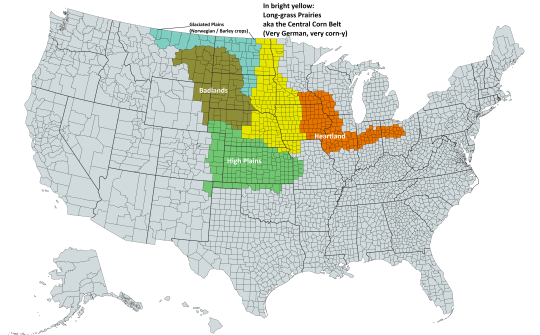
Source: Me Map 1 – Cultural Micro-Regions of the Heartland and Great Plains:
I think that this map might help to visualize where both cornfields and
rural lifestyle predominate, opening the door to rural folklore. The two
regions here where corn agriculture is predominant are the orange and
yellow regions. The orange region, the classic “Heartland”, hosts
Indiana Hoosier culture and the cornfields of Illinois and Ohio.
However, the region is marked by smaller farms and a higher population
density, and is not that rural compared to the plains further west; much
of this region also hosts larger cities and a lot of Rust Belt
industrial zones and dairy farms. The yellow region, however, is both
covered in corn and quite rural, where crops can span from horizon to
horizon. That’s where we would look for German folk culture.
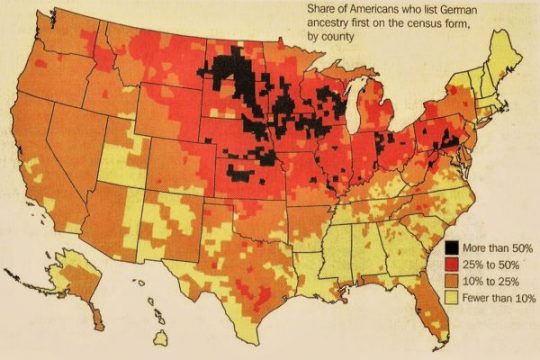
Source: An anonymous hero cartographer who’s had their work stolen by Pinterest users Map 2 – German Ancestry in the U.S.
This might help to visualize the places where predominant corn agriculture overlaps with German ancestry. Note that in much of central Wisconsin and central North Dakota, over 50% of people have German ancestry. But this land isn’t really dominated by corn. However, the region roughly from Fargo (on the Minnesota-North Dakota border) to Kansas City is both heavily German and dominated by corn. —
Anyway, feldgeister lore is scary. I’d love to hear more American versions, since a lot of the scholarship on these spooky corn-wolves is based on folk culture in Germany itself, rather than the diaspora in the U.S.
Saw this post about feldgeister’s going around again, so thought I’d make a low-effort re-post for anyone interested in “Midwestern gothic” or how local ecology influences regional folklore.
this an awesome hot take thank you!!
and just in time for halloween and the corn harvest, too 👀
this is the most exquisitely @seananmcguire blend of creepiness, scholarship, and corn that has ever existed.
Temples are built for gods. Knowing this a farmer builds a small temple to see what kind of god turns up.
Arepo built a temple in his field, a humble thing, some stones stacked up to make a cairn, and two days later a god moved in.
“Hope you’re a harvest god,” Arepo said, and set up an altar and burnt two stalks of wheat. “It’d be nice, you know.” He looked down at the ash smeared on the stone, the rocks all laid askew, and coughed and scratched his head. “I know it’s not much,” he said, his straw hat in his hands. “But – I’ll do what I can. It’d be nice to think there’s a god looking after me.”
The next day he left a pair of figs, the day after that he spent ten minutes of his morning seated by the temple in prayer. On the third day, the god spoke up.
“You should go to a temple in the city,” the god said. Its voice was like the rustling of the wheat, like the squeaks of fieldmice running through the grass. “A real temple. A good one. Get some real gods to bless you. I’m no one much myself, but I might be able to put in a good word?” It plucked a leaf from a tree and sighed. “I mean, not to be rude. I like this temple. It’s cozy enough. The worship’s been nice. But you can’t honestly believe that any of this is going to bring you anything.”
“This is more than I was expecting when I built it,” Arepo said, laying down his scythe and lowering himself to the ground. “Tell me, what sort of god are you anyway?”
“I’m of the fallen leaves,” it said. “The worms that churn beneath the earth. The boundary of forest and of field. The first hint of frost before the first snow falls. The skin of an apple as it yields beneath your teeth. I’m a god of a dozen different nothings, scraps that lead to rot, momentary glimpses. A change in the air, and then it’s gone.”
The god heaved another sigh. “There’s no point in worship in that, not like War, or the Harvest, or the Storm. Save your prayers for the things beyond your control, good farmer. You’re so tiny in the world. So vulnerable. Best to pray to a greater thing than me.”
Arepo plucked a stalk of wheat and flattened it between his teeth. “I like this sort of worship fine,” he said. “So if you don’t mind, I think I’ll continue.”
“Do what you will,” said the god, and withdrew deeper into the stones. “But don’t say I never warned you otherwise.”
Arepo would say a prayer before the morning’s work, and he and the god contemplated the trees in silence. Days passed like that, and weeks, and then the Storm rolled in, black and bold and blustering. It flooded Arepo’s fields, shook the tiles from his roof, smote his olive tree and set it to cinder. The next day, Arepo and his sons walked among the wheat, salvaging what they could. The little temple had been strewn across the field, and so when the work was done for the day, Arepo gathered the stones and pieced them back together.
“Useless work,” the god whispered, but came creeping back inside the temple regardless. “There wasn’t a thing I could do to spare you this.”
“We’ll be fine,” Arepo said. “The storm’s blown over. We’ll rebuild. Don’t have much of an offering for today,” he said, and laid down some ruined wheat, “but I think I’ll shore up this thing’s foundations tomorrow, how about that?”
The god rattled around in the temple and sighed.
A year passed, and then another. The temple had layered walls of stones, a roof of woven twigs. Arepo’s neighbors chuckled as they passed it. Some of their children left fruit and flowers. And then the Harvest failed, the gods withdrew their bounty. In Arepo’s field the wheat sprouted thin and brittle. People wailed and tore their robes, slaughtered lambs and spilled their blood, looked upon the ground with haunted eyes and went to bed hungry. Arepo came and sat by the temple, the flowers wilted now, the fruit shriveled nubs, Arepo’s ribs showing through his chest, his hands still shaking, and murmured out a prayer.
“There is nothing here for you,” said the god, hudding in the dark. “There is nothing I can do. There is nothing to be done.” It shivered, and spat out its words. “What is this temple but another burden to you?”
“We -” Arepo said, and his voice wavered. “So it’s a lean year,” he said. “We’ve gone through this before, we’ll get through this again. So we’re hungry,” he said. “We’ve still got each other, don’t we? And a lot of people prayed to other gods, but it didn’t protect them from this. No,” he said, and shook his head, and laid down some shriveled weeds on the altar. “No, I think I like our arrangement fine.”
“There will come worse,” said the god, from the hollows of the stone. “And there will be nothing I can do to save you.”
The years passed. Arepo rested a wrinkled hand upon the temple of stone and some days spent an hour there, lost in contemplation with the god.
And one fateful day, from across the wine-dark seas, came War.
Arepo came stumbling to his temple now, his hand pressed against his gut, anointing the holy site with his blood. Behind him, his wheat fields burned, and the bones burned black in them. He came crawling on his knees to a temple of hewed stone, and the god rushed out to meet him.
“I could not save them,” said the god, its voice a low wail. “I am sorry. I am sorry. I am so so sorry.” The leaves fell burning from the trees, a soft slow rain of ash. “I have done nothing! All these years, and I have done nothing for you!”
“Shush,” Arepo said, tasting his own blood, his vision blurring. He propped himself up against the temple, forehead pressed against the stone in prayer. “Tell me,” he mumbled. “Tell me again. What sort of god are you?”
“I -” said the god, and reached out, cradling Arepo’s head, and closed its eyes and spoke.
“I’m of the fallen leaves,” it said, and conjured up the image of them. “The worms that churn beneath the
earth. The boundary of forest and of field. The first hint of frost
before the first snow falls. The skin of an apple as it yields beneath
your teeth.” Arepo’s lips parted in a smile.
“I am the god of a dozen different nothings,” it said. “The petals in bloom that lead to
rot, the momentary glimpses. A change in the air -” Its voice broke, and it wept. “Before it’s gone.”
“Beautiful,” Arepo said, his blood staining the stones, seeping into the earth. “All of them. They were all so beautiful.”
And as the fields burned and the smoke blotted out the sun, as men were trodden in the press and bloody War raged on, as the heavens let loose their wrath upon the earth, Arepo the sower lay down in his humble temple, his head sheltered by the stones, and returned home to his god.
Sora found the temple with the bones within it, the roof falling in upon them.
“Oh, poor god,” she said, “With no-one to bury your last priest.” Then she paused, because she was from far away. “Or is this how the dead are honored here?” The god roused from its contemplation.
“His name was Arepo,” it said, “He was a sower.”
Sora startled, a little, because she had never before heard the voice of a god. “How can I honor him?” She asked.
“Bury him,” the god said, “Beneath my altar.”
“All right,” Sora said, and went to fetch her shovel.
“Wait,” the god said when she got back and began collecting the bones from among the broken twigs and fallen leaves. She laid them out on a roll of undyed wool, the only cloth she had. “Wait,” the god said, “I cannot do anything for you. I am not a god of anything useful.”
Sora sat back on her heels and looked at the altar to listen to the god.
“When the Storm came and destroyed his wheat, I could not save it,” the god said, “When the Harvest failed and he was hungry, I could not feed him. When War came,” the god’s voice faltered. “When War came, I could not protect him. He came bleeding from the battle to die in my arms.” Sora looked down again at the bones.
“I think you are the god of something very useful,” she said.
“What?” the god asked.
Sora carefully lifted the skull onto the cloth. “You are the god of Arepo.”
Generations passed. The village recovered from its tragedies—homes
rebuilt, gardens re-planted, wounds healed. The old man who once lived on the
hill and spoke to stone and rubble had long since been forgotten, but the
temple stood in his name. Most believed it to empty, as the god who resided
there long ago had fallen silent. Yet, any who passed the decaying shrine felt an ache
in their hearts, as though mourning for a lost friend. The cold that seeped
from the temple entrance laid their spirits low, and warded off any potential
visitors, save for the rare and especially oblivious children who would leave tiny
clusters of pink and white flowers that they picked from the surrounding
meadow.
The god sat in his peaceful home, staring out at the distant
road, to pedestrians, workhorses, and carriages, raining leaves that swirled
around bustling feet. How long had it been? The world had progressed without
him, for he knew there was no help to be given. The world must be a cruel place, that even the useful gods have abandoned,
if farms can flood, harvests can run barren, and homes can burn, he
thought.
He had come to understand that humans are senseless
creatures, who would pray to a god that cannot grant wishes or bless upon them
good fortune. Who would maintain a temple and bring offerings with nothing in
return. Who would share their company and meditate with such a fruitless deity.
Who would bury a stranger without the hope for profit. What bizarre, futile
kindness they had wasted on him. What wonderful, foolish, virtuous, hopeless
creatures, humans were.
So he painted the sunset with yellow leaves, enticed the
worms to dance in their soil, flourished the boundary between forest and field
with blossoms and berries, christened the air with a biting cold before winter
came, ripened the apples with crisp, red freckles to break under sinking teeth,
and a dozen other nothings, in memory of the man who once praised the god’s
work on his dying breath.
“Hello, God of Every Humble Beauty in the World,” called a
familiar voice.
The squinting corners of the god’s eyes wept down onto
curled lips. “Arepo,” he whispered, for his voice was hoarse from its hundred-year
mutism.
“I am the god of devotion, of small kindnesses, of
unbreakable bonds. I am the god of selfless, unconditional love, of everlasting
friendships, and trust,” Arepo avowed, soothing the other with every word.
“That’s wonderful, Arepo,” he responded between tears, “I’m
so happy for you—such a powerful figure will certainly need a grand temple. Will
you leave to the city to gather more worshippers? You’ll be adored by all.”
“No,” Arepo smiled.
“Farther than that, to the capitol, then? Thank you for
visiting here before your departure.”
“No, I will not go there, either,” Arepo shook his head and
chuckled.
“Farther still? What ambitious goals, you must have. There
is no doubt in my mind that you will succeed, though,” the elder god continued.
“Actually,” interrupted Arepo, “I’d like to stay here, if
you’ll have me.”
The other god was struck speechless. “…. Why would you want
to live here?”
“I am the god of unbreakable bonds and everlasting
friendships. And you are the god of Arepo.”
I reblogged this once with the first story. Now the story has grown and I’m crying. This is gorgeous, guys. This is what dreams are made of.
“To all mankind – may we never find space so vast, planets so cold, heart and mind so empty that we cannot fill them with love and warmth.”
·
📸: @puck90
if i had to get in a fistfight with any member of the fellowship it would be Frodo because i would easily win
all i am saying is that he would ostensibly be the easiest one to take on in a fight given that he’s like three feet tall and has led a life of (physical) leisure compared to all of the others due to his standing as a gentlehobbit
legolas, aragorn, and gimli are all used to combat, sam works as a gardener, merry and pippin often gallivant off and get into mischief so they have the advantage of experience in whatever it is they’ve gotten up to/would possibly fight dirty, gandalf is gandalf so while weapons are out of the question i suppose that depends on if magic is involved. i don’t think i could take him without magic even if he IS old because he’s a very large guy, but maybe
it would be my knuckles against Frodo’s baby soft poet hands, plus i’ve got the additional height and fighting experience. i just think that he would be the easiest to win against in hand-to-hand combat out of the rest of them. also he isn’t real so he can’t offer a rebuttal to my claim
you’re absolutely correct BUT wanting to fight Frodo makes you a monster D:
this has nothing to do with WANTING to fight Frodo, i just think he would be easiest for me to beat in a fight with no weapons. unless he utilized his very large feet, but i think he’s too polite to do that because it’s a fist fight and that would be considered playing dirty
for someone who doesn’t want to fight Frodo you sure have put a lot of thought into fighting Frodo……….
OP is wrong though: you fight Pippin.
First off, Pippin has it coming, so you won’t be fighting your conscience at the same time.
Secondly, Pippin is a spoiled rich kid. He’s no less gentry than Frodo is, but Frodo works out and is shown to have better stamina, at least at the outset. Pippin is also both the stupidest and the slowest of the hobbits. They both nearly beat one (1) troll, so that’s comparable, but Pippin appears not to have got a single hit in against the orcs that captured them while Merry was cutting off hands like a boss. Pippin also straight-up tell Bergil that he’s not a fighter.
Also there’s a nonzero chance that Frodo will just straight up curse you (if the guilt of fighting Frodo isn’t enough if a curse by itself).
And, of course, if you try to fight Frodo, you will 100% end up fighting Sam, and he will wreck you (and you’ll deserve it, you monster)
Also: if you fight Frodo you’ll have a very angry Sam & possibly also the entire Fellowship to deal with BUT if you fight Pippin they will probably cheer you on.
Bold of you to assume one could attempt to fight Pippin and NOT instantly be killed by Boromir.
So here’s the thing – you absolutely DO NOT want to try and fight Frodo or Pippin because they are going to be protected by the rest of the Fellowship, which basically exists to stop asshole Big People from picking on the hobbits. Folk might talk a big game but when the chips are down, you are not going to lay a single hand on any of the hobbits. Either you’ll find yourself immediately fighting all four of them or else you’ll move to land your first hit and suddenly Aragorn will side-tackle you into the trees. And he probably hits like a freight train tbh.
So here’s what you do:
You fight Legolas.
The thing about fist-fighting Legolas of course is that you will lose. This is not a fight you’re gonna win no matter what. But Legolas has his standing competition with Gimli, so once the challenge is issued, he’s not gonna let anyone else step in and fight you either. No one is liable to volunteer on his behalf, either, so you will only end up fighting the one member of the fellowship. If you are lucky he might also take his shirt off. Bonus!
Anyway.
Legolas will mop the floor with you, but he’s also already convinced you’re weaker than him anyway because you’re not an elf, so he’s gonna go kind of easy on you. And when you lose he will be all snide and superior about it, which means everyone in the fellowship is gonna sympathize with you, and Gimli will probably challenge him on your behalf afterwards, but here’s the key thing:
You will have lost a fist-fight to an immortal warrior prince.
That’s a way better loss to cop to than that time you tried to fistfight a pudgy gentlehobbit and got beaten to the point of unconsciousness by his gardener, yeah?
okay so tolkien tumblr is fast becoming my fave tumblr community thank you thank you all you are the true fellowship here.
We all know that Hoth was a simmering mess of hormones and stress and I would pay good money for a soap opera about them. Here are some things which Definitely Happened:
There’s a betting pool going on who takes Luke’s virginity. The favourites are Han and Leia, but Wedge Antilles has pretty good odds, and there’s a small contingent of aliens who are convinced it will be Chewie (after all, who could resist that Wookie musk? Headcanon: most alien races consider humans soft and gross. Most alien races find Wookies absurdly attractive. Han Solo isn’t the ladykiller; Chewie is.)
Leia and Han scream at each other in every corner of the base. Everyone is desperate for them to fuck. They do not. The sexual tension is so thick that it could be cut into blocks and sold as wall insulation. More than once they are ‘accidentally’ locked in a supply cupboard in the vain hope that claustrophobia will act as the catalyst that enables their frustration to spark into true love – or at least nasty raunchy cupboard sex. It does not. All that happens is that the offender has legally changed their name to escape the Wrath of Organa.
Someone paints a shirtless Han Solo on their X Wing. Leia is furious. Han is delighted: both at the highly flattering portrait (he has an eight-pack, he is shredded) and at Leia’s fury (you’re jealous princess/no I am not/you’re jealous, hey I can pose like that for you if you –). Hoth’s winter had nothing on the chilly silence that followed that suggestion.
Luke and Leia both have very graphic dreams about Han Solo. Han Solo has very graphic dreams about the twins – individually, together, he’s thirty fucking years old, why is his brain doing this to him.(Later on they will, individually, realise that due to Luke and Leia’s Force-bond they probably created a circle of Han Solo Sex Dreams: Leia had them, so Luke sensed her lust for Han which intensified his own lust for Han, which led to Luke having Han Solo sex dreams, which led to Leia lusting – and so on, and so on. For the sake of their sanity, they never share this revelation which each other.)
Luke is SO COLD. All the time. WHY DOES NO ONE APPRECIATE HOW COLD HE IS. He comes from a desert world. Of course he’s cold! What is all this white stuff? It was pretty for the first fve seconds but holy fucking Force it is so cold it burns and what the hell is going on with that? He bundles himself up in so many layers that he waddles rather than walks. Fearsome Last of the Jedi indeed.
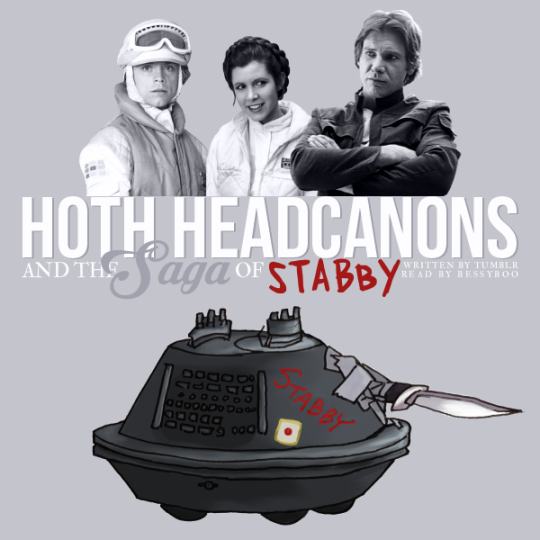
Luke tapes a knife to a cleaning droid (disc-shaped things that swish around the base, sucking up dirt) and names it Stabby. Why, says Leia. Luke, the boy from Tatooine, shining and happy despite everything says why not. Why not indeed. Stabby is very fond of chasing Han. Han wants desperately to shoot the fucking thing– but then he sees big-eyed Luke and sharp-toothed Leia cooing over it and, well. A little bit of light stabbing is nothing, compared to those two smiling.
STABBY THE SPACE ROOMBA!
I am torn between wanting Stabby to be grabbed and evacuated along with the Rebels and make it to the next base, and wanting Stabby to get Vader.
Compromise: shortly after losing the Millennium Falcon, Vader, storming through the Rebel base, is startled to feel a sudden jolt of pain from the artificial sensors on his left leg prosthetic: a sharp sensation on his ankle. Surprised, because he sensed no threat–is the limb malfunctioning?–he looks down, and there is a cleaning droid with a knife taped to it, a little painted-on Rebel lieutenant’s insignia, and the word STABBY written on it.
He stares down at it, completely and utterly taken aback for the first time in over a decade. Fearlessly, it chitters back at him, sounding very triumphant.
He picks it up.
Off in the fractal weirdness of hyperspace, Rebels on several ships are surprised to find an update on Stabby’s kill-update feed, and then thoroughly shocked at the accompanying image: the upward-pointing camera has captured an image of Darth Vader staring down at the droid.
It’s the fastest news ever to travel through the Rebel grapevine, the mix of triumph and loss that is, they are certain, Stabby’s heroic last stand.
Until a day later, when the thing updates again, this time showing an extremely confused Imperial officer. And another, and another, and another, day after day.
They cancel the funeral.
Vader hasn’t done much just for the fun of it in two decades. Watching Imperial officers swear and clutch their ankles as a cleaning drone with a knife taped to it, an Imperial emblem, lieutenant’s insignia, and the word STABBY painted on it, bumps into them and then chatters triumphantly, he’s figured he’s earned.
STABBY FIC! STABBY STARWARS FIC! YOU HAVE MADE MY DAY!
But do they send in a rescue unit to reclaim their most honorable POW?
no, the rebels are all too happy to have vader backing one of their most valuable psychological weapons. stabby’s antics are invaluable for their ability to escalate tension within imperial ranks, and vader’s personal amusement means stabby will get to keep running his miniature interference mission for a long time to come
YAAAAAAAAAAAAAAAAAAAAAAAAASSSSSS
STABBY LIVESSSSSSSSSSSSSSSSSSS
Grand Moff Tarkin limps into Vader’s quarters. Again. “Lord Vader, enough of this.”
“I have altered the droid; pray I do not alter it any further.”
(If there’s one thing young Anakin Skywalker can appreciate, it’s a hot-rodded maintenance droid, c’mon.)
VADER PUTS A LIGHTSABRE ON STABBY
HE CALLS IT HIS APPRENTICE
MY SON WILL NOT TURN TO THE DARKSIDE BUT MY SON’S STABBY SON WILL
Stabby is eventually recovered and given a medal after the defeat of the Emperor, but his poor little chassis is too badly damaged by then to even hold onto the knife anymore. His internal mechanism is removed and upgraded, and then the Master Droid Tech charged with fixing him casts around for a new casing to put him in.
“Hey!” calls a teenaged Poe Dameron, walking into the Droid repair shop. “I got this decommissioned BB-8 chassis they said to bring in here. It needs a new owner. Captain said I can have it if I can find a new mechanism for it.”
The Master Droid Tech looks at Stabby, then at the BB-8 chassis, then back at Stabby. Stabby turns his unsheathed ocular sensor to Poe and beeps adoringly. (This is a common if relatively new reaction to Poe Dameron, who has just graduated from his Awkward Stage.)
“Yeah, I got one for you right here,” the Tech says, grinning.




 Hearseeno