everythingisanthropology:

spybrarian:

erikawithac:

a-golden-lasso-of-my-own:

Yay! Feminist Anthropology time!

Prehistoric Cave Prints Show Most Early Artists Were Women

I added the emphasis in bold, but the “that” was already italicized in the article, and it’s probably my favorite part. I love this article, although I’m not a huge fan of the fact that it’s considered so incredibly shocking and radical to imagine that women possibly participated in society 40,000 years ago.

In other awesome feminist anthropology news: it is now somewhat accepted that the venus sculptures, rather than being depictions of female beauty by male artists, were self-portraits by women looking down at their own bodies. The paleolithic figurines lose their distorted proportions and acquire representational realism if we understand that they are self-portraits created by women looking down at their own bodies. 

See also: This quote by Sandy Toksvig

When I was a student at Cambridge I remember an anthropology professor holding up a picture of a bone with 28 incisions carved in it. ‘This is often considered to be man’s first attempt at a calendar’ she explained. She paused as we dutifully wrote this down. ‘My question to you is this – what man needs to mark 28 days? I would suggest to you that this is woman’s first attempt at a calendar.’

It was a moment that changed my life. In that second I stopped to question almost everything I had been taught about the past. How often had I overlooked women’s contributions? How often had I sped past them as I learned of male achievement and men’s place in the history books? Then I read Rosalind Miles’s book The Women’s History of the World (recently republished as Who Cooked the Last Supper?) and I knew I needed to look again. History is full of fabulous females who have been systematically ignored, forgotten or simply written out of the records. They’re not all saints, they’re not all geniuses, but they do deserve remembering.

the willendorf sculpture and others like her were /the first selfies/ and its amazing

The paleolithic figurines lose their distorted proportions and acquire representational realism if we understand that they are self-portraits created by women looking down at their own bodies.

I really, really love this sentence.

It’s hard to push back against the Good Old Boys but we are obligated to do it so we can see the clearest picture of the past, unbiased by the prejudices of “modern” society.
thebibliosphere:

When I was nine, possibly ten, an author came to our school to talk about writing. His name was Hugh Scott, and I doubt he’s known outside of Scotland. And even then I haven’t seen him on many shelves in recent years in Scotland either. But he wrote wonderfully creepy children’s stories, where the supernatural was scary, but it was the mundane that was truly terrifying. At least to little ten year old me. It was Scooby Doo meets Paranormal Activity with a bonny braw Scottish-ness to it that I’d never experienced before.

I remember him as a gangling man with a wiry beard that made him look older than he probably was, and he carried a leather bag filled with paper. He had a pen too that was shaped like a carrot, and he used it to scribble down notes between answering our (frankly disinterested) questions. We had no idea who he was you see, no one had made an effort to introduce us to his books. We were simply told one morning, ‘class 1b, there is an author here to talk to you about writing’, and this you see was our introduction to creative writing. We’d surpassed finger painting and macaroni collages. It was time to attempt Words That Were Untrue.

You could tell from the look on Mrs M’s face she thought it was a waste of time. I remember her sitting off to one side marking papers while this tall man sat down on our ridiculously short chairs, and tried to talk to us about what it meant to tell a story. She wasn’t big on telling stories, Mrs M. She was also one of the teachers who used to take my books away from me because they were “too complicated” for me, despite the fact that I was reading them with both interest and ease. When dad found out he hit the roof. It’s the one and only time he ever showed up to the school when it wasn’t parents night or the school play. After that she just left me alone, but she made it clear to my parents that she resented the fact that a ten year old used words like ‘ubiquitous’ in their essays. Presumably because she had to look it up.

Anyway, Mr Scott, was doing his best to talk to us while Mrs M made scoffing noises from her corner every so often, and you could just tell he was deflating faster than a bouncy castle at a knife sharpening party, so when he asked if any of us had any further questions and no one put their hand up I felt awful. I knew this was not only insulting but also humiliating, even if we were only little children. So I did the only thing I could think of, put my hand up and said “Why do you write?”

I’d always read about characters blinking owlishly, but I’d never actually seen it before. But that’s what he did, peering down at me from behind his wire rim spectacles and dragging tired fingers through his curly beard. I don’t think he expected anyone to ask why he wrote stories. What he wrote about, and where he got his ideas from maybe, and certainly why he wrote about ghosts and other creepy things, but probably not why do you write. And I think he thought perhaps he could have got away with “because it’s fun, and learning is fun, right kids?!”, but part of me will always remember the way the world shifted ever so slightly as it does when something important is about to happen, and this tall streak of a man looked down at me, narrowed his eyes in an assessing manner and said, “Because people told me not to, and words are important.”

I nodded, very seriously in the way children do, and knew this to be a truth. In my limited experience at that point, I knew certain people (with a sidelong glance to Mrs M who was in turn looking at me as though she’d just known it’d be me that type of question) didn’t like fiction. At least certain types of fiction. I knew for instance that Mrs M liked to read Pride and Prejudice on her lunch break but only because it was sensible fiction, about people that could conceivably be real. The idea that one could not relate to a character simply because they had pointy ears or a jet pack had never occurred to me, and the fact that it’s now twenty years later and people are still arguing about the validity of genre fiction is beyond me, but right there in that little moment, I knew something important had just transpired, with my teacher glaring at me, and this man who told stories to live beginning to smile. After that the audience turned into a two person conversation, with gradually more and more of my classmates joining in because suddenly it was fun. Mrs M was pissed and this bedraggled looking man who might have been Santa after some serious dieting, was starting to enjoy himself. As it turned out we had all of his books in our tiny corner library, and in the words of my friend Andrew “hey there’s a giant spider fighting a ghost on this cover! neat!” and the presentation devolved into chaos as we all began reading different books at once and asking questions about each one. “Does she live?”— “What about the talking trees” —“is the ghost evil?” —“can I go to the bathroom, Miss?” —“Wow neat, more spiders!”

After that we were supposed to sit down, quietly (glare glare) and write a short story to show what we had learned from listening to Mr Scott. I wont pretend I wrote anything remotely good, I was ten and all I could come up with was a story about a magic carrot that made you see words in the dark, but Mr Scott seemed to like it. In fact he seemed to like all of them, probably because they were done with such vibrant enthusiasm in defiance of the people who didn’t want us to.

The following year, when I’d moved into Mrs H’s class—the kind of woman that didn’t take away books from children who loved to read and let them write nonsense in the back of their journals provided they got all their work done—a letter arrived to the school, carefully wedged between several copies of a book which was unheard of at the time, by a new author known as J.K. Rowling. Mrs H remarked that it was strange that an author would send copies of books that weren’t even his to a school, but I knew why he’d done it. I knew before Mrs H even read the letter.

Because words are important. Words are magical. They’re powerful. And that power ought to be shared. There’s no petty rivalry between story tellers, although there’s plenty who try to insinuate it. There’s plenty who try to say some words are more valuable than others, that somehow their meaning is more important because of when it was written and by whom. Those are the same people who laud Shakespeare from the heavens but refuse to acknowledge that the quote “Some are born great, some achieve greatness, and some have greatness thrust upon them“ is a dick joke.

And although Mr Scott seems to have faded from public literary consumption, I still think about him. I think about his stories, I think about how he recommended another author and sent copies of her books because he knew our school was a puritan shithole that fought against the Wrong Type of Wordes and would never buy them into the library otherwise. But mostly I think about how he looked at a ten year old like an equal and told her words and important, and people will try to keep you from writing them—so write them anyway.

larinah:

hearseeno:

larinah:

elizabethrobertajones:

yarnyfan:

elizabethrobertajones:

Has anyone poured in a ton of thought to the ongoing reverse Cain prophecy dealio? It’s still working backwards in chronological order for Dean’s life vs his except I think we’ve kind of run out of backwards prophecy happening with the opposite effect at this point? (it was firmly established that Cain was Half Right about it all as in the order existed but the end result of the action was “reverse” to what he did as well – since Cain killed Abel to save him from Lucifer, Dean spared Sam and he… did the thing) 

Or is there a speculation for how this would work carrying on in reverse effect from the point of subversion that just happened?? Like, following on backwards from Cain’s story??? I’m just wondering if anyone’s put any energy into exploring this since I haven’t even tried thinking it through yet and that’s a lot of threads to gather together and I can hold maybe 2 potato in my thoughts right now… 

I was just kind of thinking about that, because now we’ve zipped on past “I killed my brother” to “My brother was talking to Lucifer, not God” and does this end with the gates of Eden being opened back up, and if you take it back far enough the undoing of Creation? that’s a little trippy.

Ah! Yes! Because I’ve been wondering about Amara vs Creation. She seemed kind of… content with the actual making of the world and it was just the metaphysics of souls and Heaven and God’s interaction with it that she’s currently got umbrage with. But she also seems to be veering dangerously close to someone who could and would unravel the whole thing out of spite to God? Like, I am concerned she’d want to unravel it and she definitely has the means to. 

If we’re working backwards though from Cain and Abel that does mean we’re working backwards through the book of Genesis right? It’s all in that one book? (look who never had to study the Bible for anything ever and knows it mostly by hearsay :P)

@larinah I (assume) was talking about how the darkness and light were at the start of the Bible? I can’t remember or figure out how to find those posts on my blog right now. 😛 But I am pretty sure there was something about the light being split from the darkness and if the speculation that Amara and God need to smush back together into one cosmic entity to settle this dispute is worth anything, that will literally be running through to the start??

I don’t know why you would assume it was me talking about the bible. I hardly ever talk about the bible.  (*Pretends that she didn’t used to teach Sunday School and lead a Bible Study group for years before becoming an atheist*)

But, yeah, I was.  😛

I was also a couple of years ago talking about Metatron pushing a big ‘restart’ button up there along with all his cosmic levers, because I’d bet money that was his original storyline before everything got accordioned out.  And then I was thinking that that was the story that perhaps got moved over to THE DARKNESS as the show keeps getting renewed.  I was thinking of it as Metatron making the big wheel in the sky spin around again for a do-over with him as the creator, but it’s interesting to think of it as THE DARKNESS spinning the wheel around in reverse for an undo instead.

She did say something about God thinking he could create better than she could, so she must have had some designs way back in the beginning herself.

Hmmm, so then does that mean that Mary and John are going to have to undress as Mary spits out an apple.  Mary is reduced to a rib, which leaps into John’s chest.  He unnames all the animals and when done, lays down to dissolve into the mud?   

I don’t know, but that last bit there is a pretty Bokononist thing to say!!

(Which would be surprisingly fitting for all of this!)

And God said, “Let Us make living creatures out of mud, so the mud can
see what We have done.” And God created every living creature that now
moveth, and one was man. Mud as man alone could speak. God leaned close
as mud as man sat up, looked around, and spoke. Man blinked. “What is
the purpose of all this?” he asked politely.
“Everything must have a purpose?” asked God.
“Certainly,” said man.
“Then I leave it to you to think of one for all this,” said God.
And He went away. 

——

God made mud.
God got lonesome.
So God said to some of the mud, “Sit up!”
“See all I’ve made,” said God, “the hills, the sea, the sky, the stars.”
And I was some of the mud that got to sit up and look around.
Lucky me, lucky mud.
I, mud, sat up and saw what a nice job God had done.
Nice going, God.
Nobody but you could have done it, God! I certainly couldn’t have.
I feel very unimportant compared to You.
The only way I can feel the least bit important is to think of all the mud that didn’t even get to sit up and look around.
I got so much, and most mud got so little.
Thank you for the honor!
Now mud lies down again and goes to sleep.
What memories for mud to have!
What interesting other kinds of sitting-up mud I met!
I loved everything I saw!
Good night.
I will go to heaven now.
I can hardly wait…
To find out for certain what my wampeter was…
And who was in my karass…
And all the good things our karass did for you.
Amen.

“Everything must have a purpose?” asked God.
“Certainly,” said man.
“Then I leave it to you to think of one for all this,” said God.
And He went away.

Excellent!  I love it.  I need to read more Vonnegut.  I’m ashamed I haven’t so far in my life.  

Hmmm.  Making me think, here.   Amara’s certainly all about the bliss of submission and abnegation of the self.   I wonder if the fact that humans giving the world meaning and free will only being possible if God goes away is the lesson that she needs to learn.  Not a new lesson in SPN.

larinah:

elizabethrobertajones:

yarnyfan:

elizabethrobertajones:

Has anyone poured in a ton of thought to the ongoing reverse Cain prophecy dealio? It’s still working backwards in chronological order for Dean’s life vs his except I think we’ve kind of run out of backwards prophecy happening with the opposite effect at this point? (it was firmly established that Cain was Half Right about it all as in the order existed but the end result of the action was “reverse” to what he did as well – since Cain killed Abel to save him from Lucifer, Dean spared Sam and he… did the thing) 

Or is there a speculation for how this would work carrying on in reverse effect from the point of subversion that just happened?? Like, following on backwards from Cain’s story??? I’m just wondering if anyone’s put any energy into exploring this since I haven’t even tried thinking it through yet and that’s a lot of threads to gather together and I can hold maybe 2 potato in my thoughts right now… 

I was just kind of thinking about that, because now we’ve zipped on past “I killed my brother” to “My brother was talking to Lucifer, not God” and does this end with the gates of Eden being opened back up, and if you take it back far enough the undoing of Creation? that’s a little trippy.

Ah! Yes! Because I’ve been wondering about Amara vs Creation. She seemed kind of… content with the actual making of the world and it was just the metaphysics of souls and Heaven and God’s interaction with it that she’s currently got umbrage with. But she also seems to be veering dangerously close to someone who could and would unravel the whole thing out of spite to God? Like, I am concerned she’d want to unravel it and she definitely has the means to. 

If we’re working backwards though from Cain and Abel that does mean we’re working backwards through the book of Genesis right? It’s all in that one book? (look who never had to study the Bible for anything ever and knows it mostly by hearsay :P)

@larinah I (assume) was talking about how the darkness and light were at the start of the Bible? I can’t remember or figure out how to find those posts on my blog right now. 😛 But I am pretty sure there was something about the light being split from the darkness and if the speculation that Amara and God need to smush back together into one cosmic entity to settle this dispute is worth anything, that will literally be running through to the start??

I don’t know why you would assume it was me talking about the bible. I hardly ever talk about the bible.  (*Pretends that she didn’t used to teach Sunday School and lead a Bible Study group for years before becoming an atheist*)

But, yeah, I was.  😛

I was also a couple of years ago talking about Metatron pushing a big ‘restart’ button up there along with all his cosmic levers, because I’d bet money that was his original storyline before everything got accordioned out.  And then I was thinking that that was the story that perhaps got moved over to THE DARKNESS as the show keeps getting renewed.  I was thinking of it as Metatron making the big wheel in the sky spin around again for a do-over with him as the creator, but it’s interesting to think of it as THE DARKNESS spinning the wheel around in reverse for an undo instead.

She did say something about God thinking he could create better than she could, so she must have had some designs way back in the beginning herself.

Hmmm, so then does that mean that Mary and John are going to have to undress as Mary spits out an apple.  Mary is reduced to a rib, which leaps into John’s chest.  He unnames all the animals and when done, lays down to dissolve into the mud?   

yarnyfan:

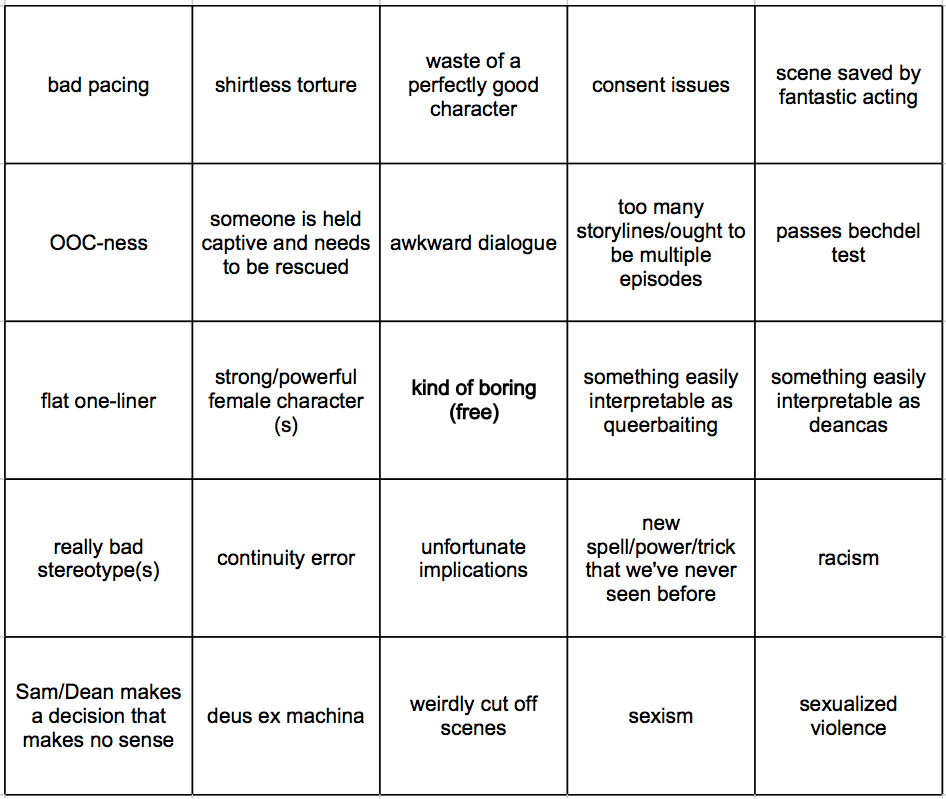
*sigh* sorry for not tagging negativity, I didn’t expect to dislike it this much? the thing is it could have been SO MUCH BETTER if almost anyone else had written it. it really was all talk talk talk talk, and remember how I said once about “Route 666″ that “most of the dialogue sounded like things the characters might actually say, and that’s high praise for Buckner and Ross-Leming”? this wasn’t that.

(Jeremy Carver, if you love us, and more importantly if you want to keep your show on the air, please put Buckleming back on MOTW duty.)

The acting was terrific. Mark Pellegrino is still good at being Lucifer. I guess the witty banter between Crowley and Rowena was almost actually witty? but. meh. Hubby actually fell asleep around the time Amara kissed Dean.

I’m right there with you on this one.  And I’m really developing an antipathy for how much they’re destroying characterization in the service of the plot.  

The Law of Diminishing Returns, true in life as well as in story, is this: The more often we experience something, the less effect it has. Emotional experience, in other words, cannot be repeated back-to-back with effect. The first ice cream cone tastes great; the second isn’t bad; the third makes you sick. The first time we experience an emotion or sensation it has its full effect. If we try to repeat this experience immediately, it has half or less than half of its full effect. If we go straight to the same emotion for the third time, it not only doesn’t have the original effect, it delivers the opposite effect.

Suppose a story contains three tragic scenes contiguously. What would be the effect? In the first, we shed tears; in the second, we sniffle; in the third, we laugh… loudly. Not because the third scene isn’t sad – it may be the saddest of the three – but because the previous two have drained us of grief and we find it insensitive, if not ludicrous, of the storyteller to expect us to cry yet again. The repetition of “serious” emotion is, in fact, a favorite comic device.

McKee, Robert. Story: Substance, Structure, Style, and the Principles of Screenwriting. HarperCollins e-books, 2010: 243. (via justanotheridijiton)