
As true King of Hell Lucifer does what he wants, when he wants.
Didn’t Crowley do something similar? Make his underlings wait while he placed chess (?) and his mother simpered?
As true King of Hell Lucifer does what he wants, when he wants.
Didn’t Crowley do something similar? Make his underlings wait while he placed chess (?) and his mother simpered?
Also interesting that Sam has been portrayed as being able to bridge communication barriers – ASL, French….Dean
Dean sniffing food and finding it spoiled or wanting.


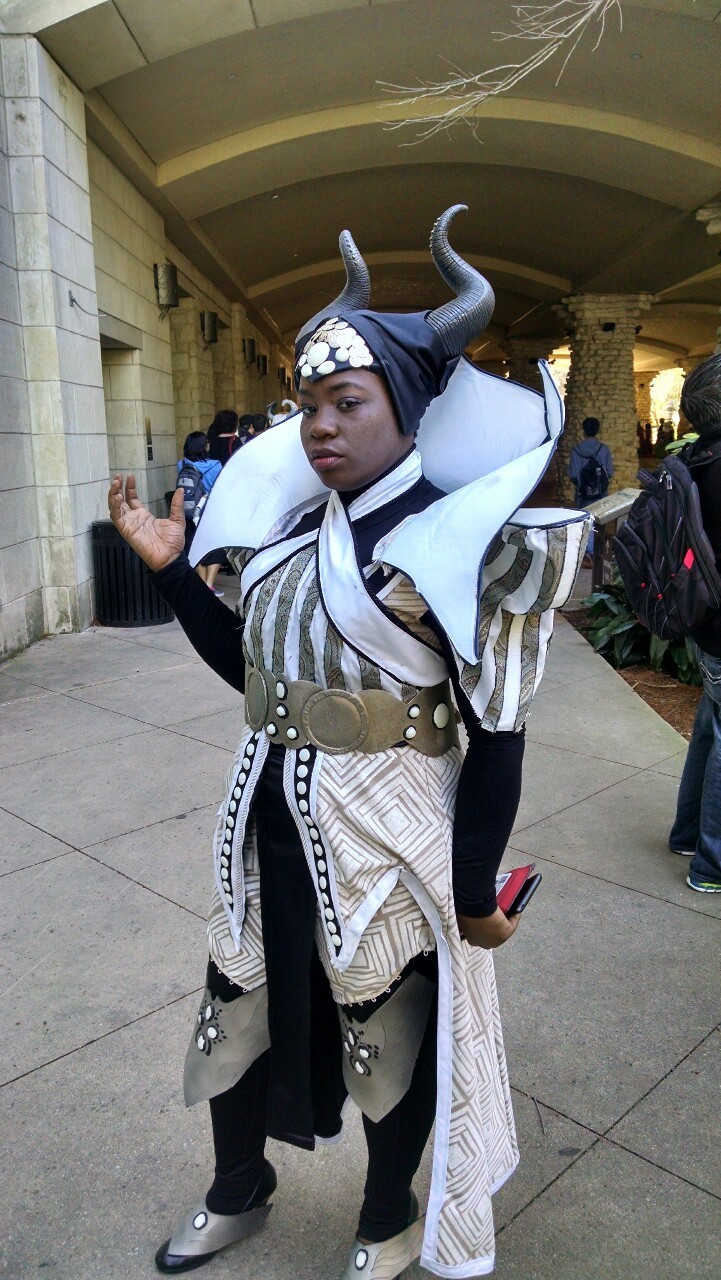
Character: Aveline de Grandpré
Series : Assassin’s Creed
SUBMISSION
Jowett, Lorna. “Purgatory with Color TV: Motel Rooms as Liminal Zones in Supernatural.” TV Goes to Hell: The Unofficial Road Map of Supernatural. Eds. Stacey Abbott and David Lavery. ECW Press, 2011.
In the movies, the motel is usually a temporary stop en route to somewhere else. The motel (or hotel) offers a transitional space where the protagonist experiences a crisis of identity – when the crisis is resolved, the protagonist moves on. A television show, though, might be predicated on an endless journey, following protagonists who travel across the country, rarely stopping for long, never establishing a home. In such shows, life on the road defines characters as well as structuring narrative. Route 66 (1960–1964), an early example, is cited by Supernatural creator Eric Kripke as an influence (“Pilot” commentary). The Incredible Hulk (1978–1982) combined the road format with a superhero story and The X-Files (1993–2002) featured FBI agents based in Washington who traveled across the U.S. to investigate paranormal events. Supernatural draws on these earlier shows, combining horror, the fantastic, and the road genre to present ever-moving protagonists in the Winchester brothers, Dean and Sam, and their mission of “saving people, hunting things.”
Dean and Sam not only cross physical space to investigate the supernatural, they also pass between different dimensions (literally when Dean goes to Hell and then returns), and (via hauntings from the past) between times, so liminal zones feature frequently. Motels are non-places, between places, “purgatory with color TV,” as Katherine Lawrie Van de Ven suggests (235) and the motel rooms the Winchesters stay in replicate other sites where borders between the supernatural and the mundane blur. Motel rooms in Supernatural have an aesthetic function: signifying Anytown, USA, they are generic but distinctively American, providing visual flourishes in the generally dark, washed-out landscape of the show. When the Trickster traps Dean and Sam in a TV land fantasy (“Changing Channels,” 5.8), this grittiness is exaggerated by the brightness of the “sitcom” motel room compared with the “real” motel room – it is the same room with the same décor but one pops with color, the other is dull and slightly worn. Furthermore, as spaces for both exposition and emotion, motel rooms also serve a plot function, enhancing their thematic significance: the Impala may be the Winchesters’ “home,” as the season 5 finale suggests, but life in motel rooms has shaped who they are. Van de Ven notes, “trading in the purgatorial gray areas of identity, hotel/motel films provocatively employ marginal, transitory spaces to speak to experiences of complexity or uncertainty” (236–237). Supernatural’s motel rooms are key sites of uncertainty, even contradiction, that relate as much to the brothers’ identity as to supernatural phenomena.
Read on Google Books*: 33-34, 35-36, 37-38, 39-40, 41-42, 43-44, 45-46.
*Last accessed February 13, 2016.
Liminal spaces in myth are places of power. Saints and heroes are born in doorways. Evil creatures fear to cross riverbanks. They are places of thresholds, the transition from one state to another. When you cross the threshold, you are neither in the state you were before nor in the state that is yet to come. In that very moment you are free to be whatever you choose.
Supernatural, particularly in the early seasons, is full of images of motel rooms that are temporary stopping places along an asphalt river. Gas stations and convenience stores that are places of refueling but not really habit and routine. Their “home” is a vessel along the journey. They are neither in one state or the other. On the road and at home. They stand in the doorway between human and monster, at times with one foot more firmly on one side of the frame than the other.
These past several seasons have been filled with images of boats, the road, rivers, stars, and maps. And now, in this current season, we’re seeing stop signs, road blockages, and “end of the road” signs. At the same time, we’re seeing the Winchesters’ enjoyment of the pleasures of homemade meals, stopping at nursing homes, and getting constant reminders that the Winchesters are getting older. They’ve been traveling through liminal spaces for a long time. Makes me wonder what it’ll take for them to commit to one side of that doorway or the other.
I’m seeing conversation about lying and the Gadreel situation going around my dash again. I’m not up to date on s10, like, at all, but it seems like an opportune moment to repost something I posted on LJ at the mid-point of s9, because it’s still the fundamental thing that needs to be resolved for me.
Here beginning the c&ped LJ post: I’ve seen a lot of people describe the storyline of s9 as being about keeping secrets, or lying. I’ve seen people suggest that Dean wasn’t wrong to do what he did, only to lie about it.
That’s technically true, in a way. If Dean hadn’t lied, and if he hadn’t lied at one remove by approving Gadreel’s trick, Dean wouldn’t have done anything wrong. But that isn’t because Dean’s moral misstep was dishonesty. It’s because lying was the means of what he did wrong, and he wouldn’t have been able to accomplish that wrong without the lies. Dean didn’t do something and then lie about it, he did something (continuously and repeatedly) for which lying was the necessary instrument. It’s like the concept of the speech act: certain kinds of speech aren’t speech about something, they are speech as action: taking an oath, for instance. Dean’s lies in s9 weren’t lies about what he did, they were lie acts that accomplished what he did.
What Dean’s lies accomplish is the taking away of Sam’s consent. When Uther appears to Ygraine in the form of her husband because Ygraine would not have had sex with him or conceived Arthur if she had known he was Uther and not Gorlois, Uther’s crime wasn’t dishonesty, it was rape. When Gadreel – with Dean’s knowing authorization and collaboration – appeared to Sam as Dean to get Sam’s consent to something Sam didn’t know he was consenting to, what he accomplished, and what Dean knew he would accomplish, was access to Sam’s body and mind without Sam’s consent. The lie was only an instrument to a multilevel, controlling invasion of a person’s selfhood.
Dean went into the plan intending to tell Sam right away. Gadreel persuaded him otherwise. Gadreel persuaded him not by holding his control of Sam’s body over Dean’s head in a hostage situation (that was a card Gadreel played only once before the reveal, over the question of kicking Cas out of the bunker), but by threatening Dean with what SAM would do if the possibility of consent were returned to him: Sam would choose to throw Gadreel out and would then die. Gadreel’s argument didn’t change, from 9.1 to 9.8. I’ve seen several discussions of 9.8 that claimed that Dean tried to tell Sam but Gadreel prevented it, but that isn’t really true: Gadreel persuaded Dean not to tell Sam, again, and he used the exact same argument as ever: giving Sam awareness would return power over his body and his choices to Sam. Dean chose again not to allow that.
It has been argued that Sam was in a coma, and Dean was authorized to make decisions regarding his body, as a loved one is in a real world medical circumstance. That analogy doesn’t hold. Sam was aware, and was capable of making an informed decision whether or not to move on. Dean knew that; he eavesdropped on part of Sam’s conversation with Death. Nor was Dean making a decision in ignorance of what Sam’s wishes would be. He explicitly believed, not that Sam wanted to die and would refuse all measures, but that possession by an angel was a specific measure Sam would specifically refuse. And Dean had a means of communicating with Sam. The same access he had to Sam’s mind through Gadreel could have been used as effectively to tell Sam the truth and let Sam choose whether to let Gadreel in as to trick him. Finally, since the ruse of Gadreel impersonating Dean depended for its success on Sam being willing in general terms to choose to live, Dean’s decision can’t be seen as the prevention of suicide.
So, no, it’s not enough for Dean to regret dishonesty and agree to be honest in the future. Dean doesn’t have a right to exercise control over Sam’s choices, Sam’s consent, Sam’s mind, Sam’s body, or Sam’s memory. He doesn’t have a right to do it by means of lying, but nor would he have the right to do it by means of more honest force. Sam belongs to Sam. And no one, ever, should have a person in their life who doesn’t accept their most basic autonomy, their control over the most fundamental boundaries of the self and the most basic decisions regarding what happens to the self. The earning back of trust, if it’s going to happen, can’t just be a matter of Sam being able to believe that things Dean says to him are true, it has to be a matter of Sam being able to believe that to Dean he is his own subject, not an object Dean can’t bring himself to let go of and therefore usurps power over. There’s nothing beautiful about a love that erases the subjecthood of its object, and the sentimentalization of roofies and noncon as “Dean just loves Sam too much” frankly makes my blood run cold.
This isn’t to say that Dean is irredeemable, that the evil thing he did was done out of malice or was incomprehensible given Dean’s damage and issues, or that his relationship with Sam can never be repaired. But the attitude that “Dean will always save Sam – never change!” well, I can see it in a way, but it would be a dark future for Spn, a future in which Dean’s love would be the monster, the Big Bad. It would be a damn effective horror story. In the end, though, I’d prefer the more optimistic version in which Dean can change, must change, and does change.
Yep, these are exactly my issues with the dynamic between Dean and Sam, particularly in the last few seasons.
Sam was initially defined as the object of "Watch out for Sammy,” a thing – a valued thing, but a thing nonetheless – with no regard for his autonomy. Dean’s actions are an outgrowth of the family values that John put into place in order to cope with the situation they were in. And perhaps they were key to surviving the angelic and demonic plans for them, but holding on to these values and ways of seeing each other have very significant costs.
We’re talking a lot about Dean, but I also have to wonder about the cost to Sam that we’re continuing to see played out here. I have to wonder how much of “I don’t want to do this without my brother” is informed by Sam buying into the old family view of himself.
If Dean has subsumed responsibility for Sam’s bodily autonomy, the converse would be that Sam doesn’t exist outside of his relationship with Dean. And so, when I see Sam forgiving his brother time and time again, being emotionally supportive regardless of the path Dean is taking, and being so hyper vigilant to the times he has let Dean down, I always have a bit of a twinge. While on the surface, Sam’s behavior is laudable, I just keep wondering about how easily he sells off these bits and pieces of himself in order to maintain his relationship with Dean, simply because he wouldn’t exist as a person if he didn’t.
counterpoint to all those cute “little girls looking up to rey” stories: i saw a little boy stab his father with kylo ren’s lightsaber at target the other day
I’m confused…they used their words…
Like, not wallpaper silent storytelling shit but actual WORDS…
If you can’t talk about it, you shouldn’t be doing it. 😉
 Hearseeno