npr:
Kristen Hawkes is an anthropologist at the University of Utah. She tries to figure out our past by studying modern hunter-gatherers like the Hadza, who likely have lived in the area that is now northern Tanzania for thousands of years. Groups like this are about as close as we can get to seeing how our early human ancestors might have lived.
Over many extended field visits, Hawkes and her colleagues kept track of how much food a wide sample of Hadza community members were bringing home. She says that when they tracked the success rates of individual men, “they almost always failed to get a big animal.” They found that the average hunter went out pretty much every day and was successful on exactly 3.4 percent of those excursions. Which meant that, in this society at least, the hunting hypothesis seemed way off the mark. If people here were depending on wild meat to survive, they would starve.
So if dad wasn’t bringing home the bacon, who was? After spending a lot of time with the women on their daily foraging trips, the researchers were surprised to discover that the women, both young and old, were providing the majority of calories to their families and group-mates.
Mostly, they were digging tubers – which are deeply buried and hard to extract. The success of a mother at gathering these tubers correlated with the growth of her child. But something else surprising happened once mom had a second baby: That original relationship went away and a new correlation emerged with the amount of food their grandmother was gathering.
She describes this finding as “mind-blowing.” In this foraging society, it turns out, grandmothers were more important to child survival than fathers. Mom and grandma were keeping the kids fed. Not Man the Hunter.
This finding led Hawkes to completely re-evaluate what she thought she knew about human evolution. Grandmothers were crucial in this environment to childhood survival. So maybe it wasn’t an accident that humans are the only great ape species in which women live so long past reproductive age. If having a helpful grandmother increased a kid’s chances of survival, natural selection may well have started selecting for older and older women. (This endowment would have passed also to human men.)
Why Grandmothers May Hold The Key To Human Evolution
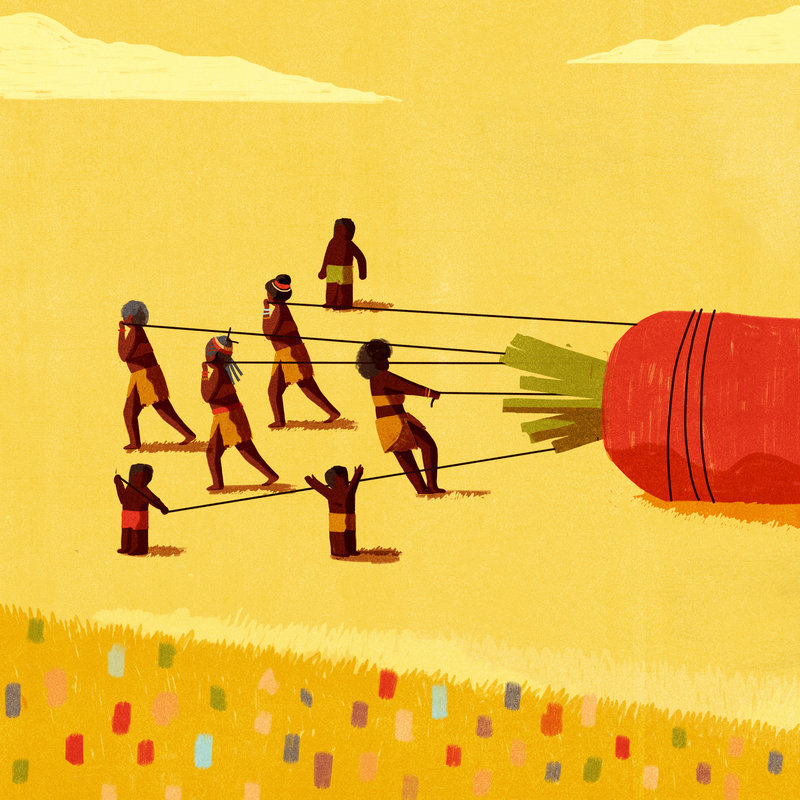
Illustration: Fabio Consoli for NPR

 Hearseeno