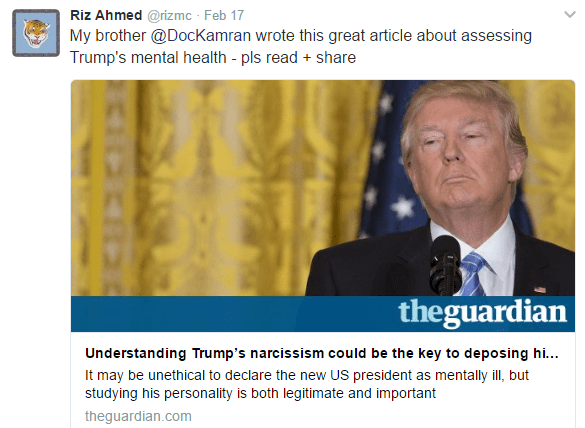
a) riz ahmed’s big bro is a psychiatrist. idk why this makes me so happy, but it does.
b) the article is a good read. it’s one thing to recognise narcissistic traits in a public personality and to discuss narcissism in a general sense, but when you’re putting the weight of your profession behind your opinion, you’d damn well put some professional groundwork in first. which in psychiatry usually means a one-on-one structured diagnostic interview. dr. ahmed talks about observation over a period of time to diagnose unco-operative/distressed patients but that’s still something done under relatively controlled conditions and hardly applies for the diagnosis of a personality disorder.
c) i can’t imagine diagnosing trump with a mental illness does any good at all–either in terms of countering his policies or the people he surrounds himself with, or in reducing the stigma and prejudices around mental illness in general, or to the reputation of psychiatrists and psychiatry as a valid medical science.
I agree that arm-chair diagnoses are fraught with dangers both to the subject but also to the person performing them.
I don’t think it’s helpful to go out on a limb and diagnose someone – when the process of diagnosing someone is 1) for treatment purposes, 2) done under controlled circumstances that don’t exist here. We’re comparing apples to oranges, not apples to apples, and then drawing conclusions. (As a technical aside: I keep seeing quotes about Dr. Allen Frances about Trump not meeting criteria because of the lack of distress or impairment. Dr. Frances wrote the criteria for a former version of the DSM – the new criteria for personality disorders in place since 2013 do NOT include anything about needing to experience distress or impairment. – which is all beside the point, because we never get to see the private version of Trump and so how would we know if he experiences distress and impairment, anyway.)
I think I’m agreeing with Dr. Ahmed here in saying I do believe it is helpful to talk about personality traits – what are the things we have seen across similar situations that help us be able to be reasonably certain we’re going to see them again in another similar situation. So, comparing oranges to oranges – what have we seen of the public version of Trump that can help us predict what he is likely to continue doing as the public version of Trump?
- It is unreasonable to hope that he will ever, ever “pivot.” He is who is regardless of context.
- He feeds off of positive regard, and will say and do anything to obtain it from the person(s) in front of him. And if he’s not getting it, he will reject and marginalize.
- It is unreasonable to expect him to be rational. He believes what he believes, and what he believes is not directly related to reality.
- It is unreasonable to expect him to be consistent. Because it is not directly tied to reality, what he believes will be unstable. It will change from moment to moment to suit the needs of the moment.
- It is unreasonable to expect him to follow societal norms. He will not adhere to expectations for his behavior based on any form of social contract. It doesn’t matter if it’s “don’t use your handshake as a play for dominance,” or “don’t leave your wife behind when getting out of the car to go somewhere” or “don’t mess with the balance of power between the three branches of government because that path leads to the death of democracy.”
- The drama is the point. Everything else is secondary. It is not reasonable to expect that he will “learn” from the “mistakes” of this first month. It is not reasonable to expect good communication and planful development and application of policy. There is little motivation and effort put into these kinds of things, because the emotional high is the point. If things go more smoothly, it will be because people in his administration have learned better how to manage him, but there will always be disruptions.
I really wish we could have had these discussions in a way that had more impact. Because we, as a society, keep expecting him to act in a certain way that he is just NOT going to act – and then we keep being shocked. If we don’t take these traits seriously, then we’re constantly caught in a cycle of shock, outrage, and reaction. We, as a society, keep giving him the emotional reactions that feed the cycle. We’re constantly a step behind.

 Hearseeno